“Lead my sheep: Mary and the Church that are born from the Resurrected.”
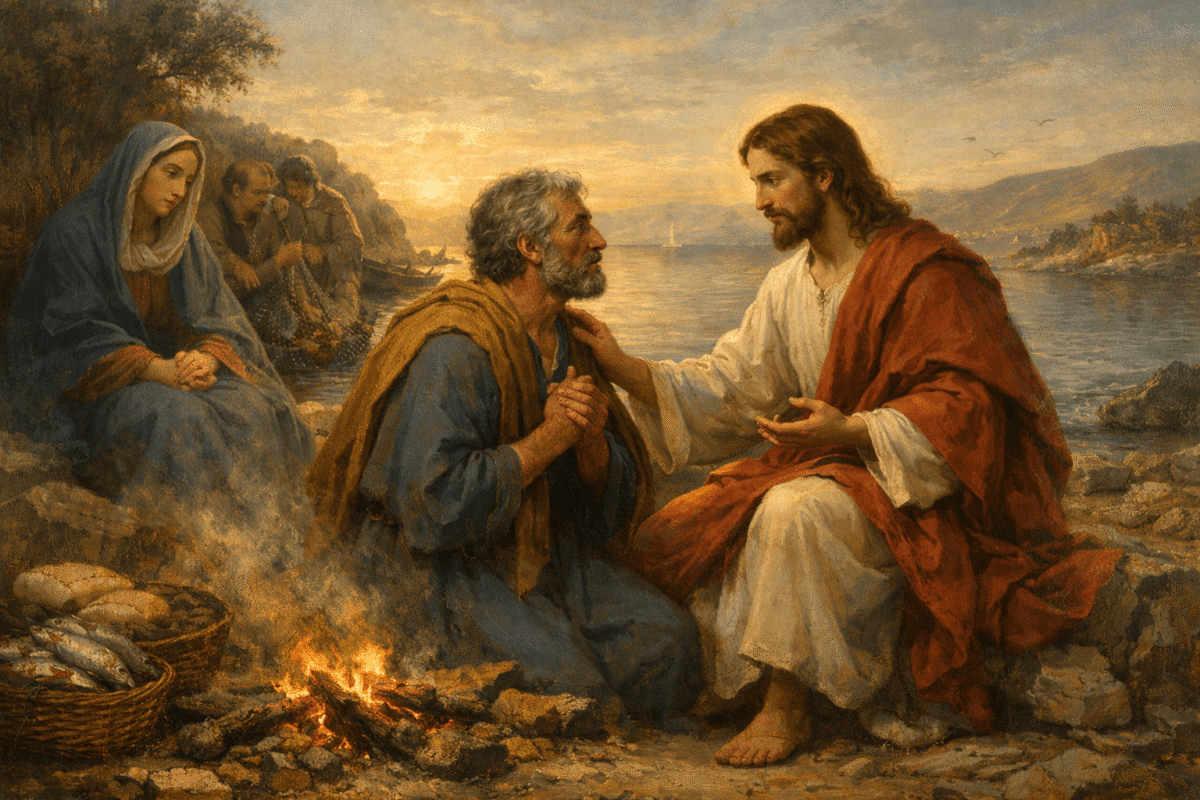
The Third Sunday of Easter in Year C: The Appearance of the Risen One and the Rehabilitation of Peter
The Appearance of the Risen One and the Dawn of Easter
“When it was already dawn” (Jn 21,4), dawn is, in the Gospel of John, the time of the Easter appearances. Mary Magdalene found the empty tomb at dawn (Jn 20,1). The disciples find the Risen One at dawn, marking the beginning of the Easter dawn, the moment when the night of the tomb transforms into the light of resurrection.The Marian tradition sees in Mary the *dawn* par excellence, the one who precedes the Sun and announces it. This image, from the Fathers Jerome and Ambrose, was taken up by Benedict XVI in the *Verbum Domini* (n. 88): “Mary is the perfect model of how the Word of God transforms human life.” At the dawn of Easter, Mary is the creature who first, with unshakable faith, welcomed the resurrection, even without sensible vision.The Recognition of the Risen One: Contemplative Love and Pastoral Action
The miraculous catch of fish that precedes recognition (Jn 21,6-7) symbolizes the new Eucharistic sign: the disciples, after a night of fruitless work, are blessed with an abundant catch under the guidance of the Risen One.The mission entrusted to Peter, “feed my sheep” (Jn 21,17), is not self-referential but refers to the care of Christ’s sheep. This structure of service defines the essence of the hierarchical ministry in the Church, where the pastor always acts in the name and with the authority of Christ.Mary, Mother of the Church and Maternal Model
Paul VI’s proclamation at the conclusion of the Second Vatican Council, of Mary as *Mother of the Church* (Redemptoris Mater), synthesizes a tradition that spans the Fathers, the Liturgy, and medieval theologians. Mary, as Mother of Christ and mother of all members of His Body, is the ultimate foundation of all ecclesial pastoral care.The Church that shepherds Christ’s sheep does so best with the disposition of Mary, with unconditional love, patience, and constant intercession. The prophecy of Peter’s martyrdom (Jn 21,18-19) reminds us that following Christ implies loss and sacrifice, but also radical freedom, as demonstrated by Mary in following the Son at every moment of His life and suffering.Conclusion: Mary, Keeper of Memory and Model of Love
The conclusion of the Gospel of John (Jn 21,25) suggests that the story narrated is only the beginning. Mary, with her unwritten memory and living tradition, continues to be the keeper and mediator of this spiritual heritage. The Risen One who asks “do you love me?” and sends forth to shepherd the sheep gives rise to a Church that has Mary as its model of faithful love. May this III Sunday of Easter deepen in us our faith in her who is, at the same time, Mother of Christ and Mother of the Church.Graduate Studies in Mariology
Wishing to deepen your formation in Mariology? Discover the Graduate Studies in Mariology from Locus Mariologicus – an academic formation that combines theological rigor, spiritual life, and the living tradition of the Church.
Would you like to study Mariology seriously?
This article draws on the works of the Locus Mariologicus library. The Postgraduate Programme in Mariology takes you to the same sources with academic guidance: Scripture, the Church Fathers and the Magisterium, from the first dogma to contemporary questions.

Responses