She built her house on rock: Mary and the foundation of faith
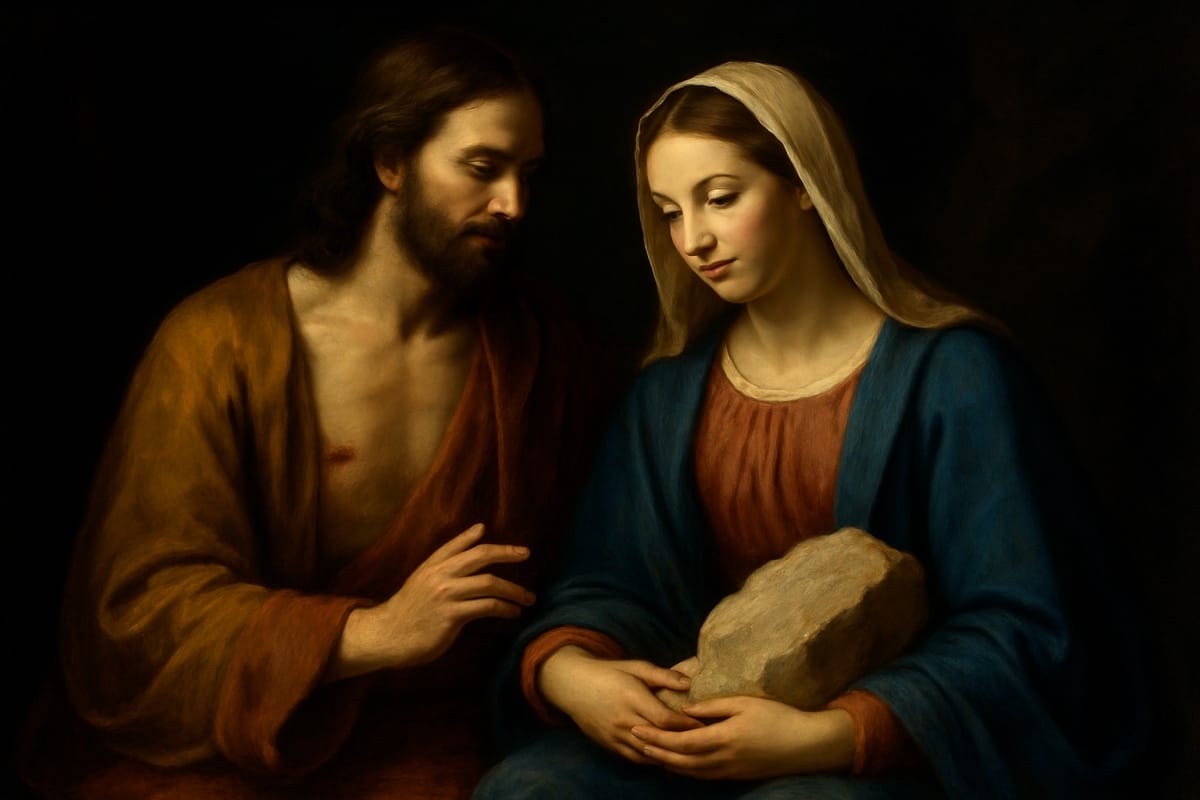
The Church’s liturgy reads Lc 2:19 (“Mary kept all these things, pondering them in her heart”) as a description of contemplative perseverance: Mary did not resolve the difficulties conceptually but kept them in her heart, allowed them to mature, and trusted that the Father “who sees in secret” was present in what she did not understand. This disposition—to keep in one’s heart what is not understood, entrusting to the Father what surpasses comprehension—is the “house built on rock” in spiritual terms: not complete understanding but faithful trust.
III. Mary, Foundation and Model of Faith
Mariology develops the image of the “house built on a rock” specifically: Mary is, in tradition, not only the model of one who built well, but also the “place” where the Church finds its foundation. Marian devotion understands Mary as Mater Ecclesiae—Mother of the Church—precisely because she is the model of the “fiat” that grounds faith: all authentic faith has the structure of the Marian fiat, openness to the gift, trust in the promise, availability for mission.
The parallel between Mary and Peter as foundations of the Church was developed by contemporary ecumenical theology. Peter is the rock (Mt 16:18) on which Jesus builds the institutional Church. Mary is the model of personal faith that sustains the spiritual Church. Both dimensions are necessary: without the institutional foundational stone of Peter, the Church lacks unity and continuity. Without the spiritual foundational aspect of Mary, the Church lacks the depth of living faith and radical following. The house built on a rock within the Church is constructed on the conjunction of both.
John Paul II, in Redemptoris Mater, developed the distinction between the “Petrine” and “Marian” dimensions of the Church, following an intuition from Hans Urs von Balthasar. The Petrine dimension is that of ordained ministry, magisterial authority, apostolic succession. The Marian dimension is of holiness, contemplative faith, love that precedes and surpasses ministry. This distinction does not oppose the two dimensions but recognizes that the Church cannot be reduced to its institutional aspect: its deeper life is the holiness of its members, concrete love expressed in service, faith that “does the will of the Father.”
The end of the Sermon on the Mount, “the crowd was amazed at his teaching, for he taught them as one having authority, and not like their scribes” (Mt 7:28-29), is an affirmation of Jesus’ authority that contrasts with authority derived from tradition. Jesus does not teach “as it is written in Moses,” but “I tell you”: it is his own authority, not that of a tradition that precedes him. This authority, which “amazed” the crowd, is the ultimate foundation on which the disciple’s house is built. Mary was the first to recognize and embrace this authority: before the Sermon on the Mount, before the public proclamation, she said “yes” to the word of the angel who announced the bearer of this authority.
IV. Jesus’ Authority and the End of the Sermon
The «authority» (exousia) of Jesus that impressed the crowd is a central theme in Matthew: Jesus acts and teaches with an authority that the scribes did not have because it was derived, not original. The scribes quoted tradition («it is written… says Rabbi Fulano»). Jesus affirmed with his own authority («I tell you»). This authority is not arrogance; it is the authority of the Son who knows the Father from within, not from without. The crowd senses this difference, even if they cannot articulate it: there is something in Jesus’ teaching that sounds different from anything they have heard before.The criterion for authority is relevant to the discernment of prophets spoken of in Matthew 7:15-20: false prophets have derived authority, from gifts, followers, or reputation, which can impress but is vulnerable to the test of fruits. Jesus’ authority is of a different kind: it does not impress through performance but through truth. «No one ever spoke like this man» (John 7:46), the admiration of the guards sent to arrest Jesus is spontaneous recognition of an authority that does not use human power tools to impose itself.Mary recognized this authority before the crowd: at the moment of the Annunciation, she welcomed the word of the angel as the word of God, not because it brought a verifiable credential, but because it resonated as true in the heart that lived «in communion» with God. This ability to recognize the authority of the Spirit, which does not impose itself by force but through resonance with the deepest part of the heart, is the fruit of a life of prayer, Lectio Divina, and fidelity to the tradition of Israel. Mary recognized the Son because she knew the Father. She welcomed the Word Incarnate because she knew how God’s Word sounds.The Sermon on the Mount does not end with an invitation to admiration but to building: «whoever hears these words and puts them into practice». Admiration is insufficient. Discipleship demands construction. The house on the rock is not contemplated, it is built, brick by brick, decision by decision, act of love by act of love, over a whole life. Mary is the model of this patient building: not the spiritual genius of a single moment, but the daily fidelity that, over a whole life, built a house that no storm, sword of Simeon, or Calvary could destroy.Post-Graduate Studies in Mariology
Would you like to deepen your formation in Mariology? Discover the Post-Graduate Studies in Mariology by Locus Mariologicus – an academic formation that combines theological rigor, spiritual life, and the living tradition of the Church.
Would you like to study Mariology seriously?
This article draws on the works of the Locus Mariologicus library. The Postgraduate Programme in Mariology takes you to the same sources with academic guidance: Scripture, the Church Fathers and the Magisterium, from the first dogma to contemporary questions.


Responses