The Marian principle of the Church: Mary at the cross
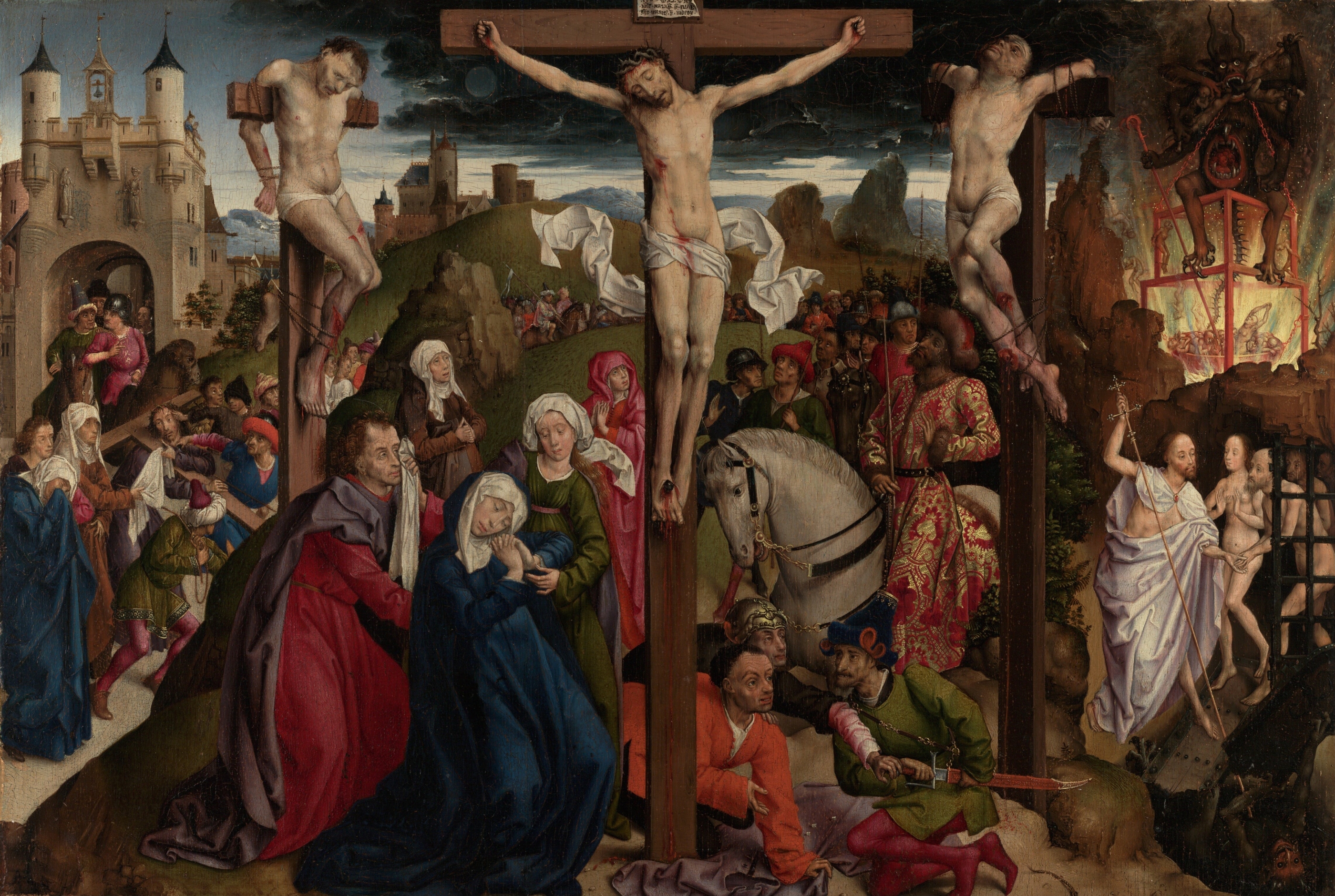
The presence of Mary at the cross of Jesus constitutes the highest moment of her maternal participation in Christ’s redemptive work, where she uniquely embodies the maternal participation of the Church.
Image:

In the presence of Mary at the cross, one can summarize what is called, both in the teaching of John Paul II and in theology, the Marian Principle of the Church. However, this is not a return to the theme of the first principle of Mariology, based on a recent past. With this principle, we aim to affirm the light and action that comes from Mary’s person and her singular participation in the mystery of redemption. John Paul II, in his Letter to Women (1995), prophetically announces further development within the Church in the third millennium, linked to new and surprising manifestations of the female genius (no. 11), in harmony with the Marian Principle of the Church.
This principle is defined in a multifaceted context: that of the relationship between the Church and Mary, between Church-Mary and Christ’s sovereign redemptive mediation, and between Mary and the identity of women. Indeed, while the relationship between Christ and the Church-Mary finds its roots in the earliest Christian tradition, from Scripture itself, it also becomes particularly significant for the issue of women, which is a sign of our times. In reality, the role of women emerges in the salvific history through the presence of the feminine, from the first pages of Scripture (Gn 1-3) to the last (Rev 12, 21).
The Marian Principle of the Church: A Female Principle
It is necessary from the outset to affirm, in order to avoid misunderstandings and for a correct evaluation, that the “Marian principle of the Church” cannot be asserted autonomously. It must always be considered in relation to another principle, the structural sacramental-petrine principle, with which it should be deeply united. It is within this relationship that the original value of the Marian principle of the Church is defined, where it is not affirmed that the Church as an “institution” depends from Mary. Rather, as Paul VI stated, one must understand that “the reality of the Church does not exhaust itself in its theological structure, its liturgy, its sacraments, or its juridical norms. Its intimate essence, the first source of its sanctifying effectiveness, must be sought in its mystical union with Christ.”
In this vein, it is also necessary to affirm, as cited from the New Catechism of the Catholic Church, quoting John Paul II, that the structure of the Church “is completely ordered to the holiness of the members of Christ. And holiness is measured according to the ‘great Mystery’ in which the Bride responds with the gift of love to the gift of the Spouse.” Mary precedes us all on the path to holiness, which is the mystery of the Church, the “spotless and wrinkle-free Bride” (Eph 5:27). For this reason, “the Marian dimension of the Church precedes its petrine dimension.”
The Female Principle in Scripture, the New Testament, and Patristic Tradition
The importance of female figures through which God’s people is represented in both the Old and New Testaments and in patristic tradition is well-known. The mystery of the Church is symbolically expressed through figures such as the New Eve, Mother, Bride, and Virgin. The relationship between Christ and the Church, illustrated through these female figures, seeks to convey that if Christ is at the center of God’s original plans, which He elected and decided to recapitulate in Him (Eph 1:10), then neither the Church nor all creation are ever absent from this divine plan. Indeed, the Church is not merely a setting in which this plan unfolds but an essential partner in the divine work.
The fundamental argument for this assertion rests on the fact that there cannot be a genuine revelation of God without His “interiorization within the consciousness of a faithful community.” Thus, the original and ever-living offer of the Trinitarian redeeming love, revealed through Christ’s crucifixion and resurrection, evokes a faithful response to this same love. However, this response is itself the fruit of the Father’s initiative, the Son’s action, and the Holy Spirit who prompts it within human hearts.
The Role of Mary in Catholic Theology
It can be argued that, according to the Father’s plan, in correspondence with the “Lamb slain from the foundation of the world” (Revelation 13:8), there is also an eternal “female partner” of Christ: the presence of the faithful community, the Church, which early on in Tradition was also referred to as Mary. Therefore: “Just as the Proto-Evangelium (Genesis 3:15) indicates an ecclesia from Adam, so it indicates an ecclesia from Eve-Mary, in which the woman is given the first place in the new beginning of creation (2 Corinthians 5:17) that will be realized in Christ, the New Adam.” The personification of the Church’s mystery in feminine images reaches a completely unique moment in the historical and real person of Mary of Nazareth, culminating in her presence at the cross and the praying community in the Cenacle awaiting the coming of the Spirit (Acts 1:14). It is in her that the personal mystery of the Church is concretely and symbolically realized. Throughout tradition, both patristic and medieval, the relationship “Church-Mary” tends to merge “within the framework of a motherhood identical, at once virgin and esponsal, by which the opening of Mary’s womb is the opening of the Church’s womb.”
The Birth of the Church in the Fathers: The New Eve and the Sacramental Mystery Emerging from the Crucified
In the theological reflection of the Fathers, the “female principle” of the New Eve is initially affirmed in contemplating the birth of the Church as a “sacramental mystery,” stemming from the event on the cross, in the description of the spear thrust and the flow of blood and water (John 19:34-37). In this narrative, the patristic tradition, recalling the symbolic description of Genesis (2:21-23), sees its fulfillment in the origin of the Church alongside the New Adam during his death sleep. She, as his Bride of the new ages, is filled with the abundance of Christ’s grace, not to fill a need, but to meet ours. In this episode of the Gospel account of Jesus’ crucifixion, one can say that the nuptial bond between the Word and humanity is consummated, and the petrine sacramental face of the Church is defined. The Church, born from blood and water, as a “sign of Christ’s presence” (Lumen Gentium 48) in history, continues the exercise of priestly ministry as its “Body” and the “universal sacrament of salvation.”
Many Fathers do not attach significant theological importance to Mary’s scene at the foot of the cross (John 19:25-27). Instead, it is commented on as an expression of Christ’s filial piety towards his Mother.
Considered in this light, the sacramental face of the Church, born from Christ’s pierced side on the cross, reveals more clearly the presence of Christ himself in his pastoral ministry. It participates in Christ’s salvific mystery, in the action of his sacrifice, continuing throughout history its permanent priestly ministerial function, and emphasizes both its unity with Christ and Christ’s presence in its liturgical life (SC 7.11). The predominance of the cristological-sacramental-Petrine perspective in the image of Eve-Church draws it closer to Paul’s idea of the Body of Christ.
No entanto, ao focar exclusivamente na unidade da Igreja com o ministério de Cristo, como sinal vivo do seu amor pelos homens, corre-se o risco de despersonalizar a Igreja. Ela se tornaria apenas uma função cristológica, ou seja, a presença comunicativa do Ressuscitado e sua oferta de graça para a humanidade. O Concílio Vaticano II, para evitar esse perigo, destaca o caráter particular desse sinal sacramental, que, além de remeter à Pessoa e ministério de Cristo, envolve sua realidade social, visível e humana, tornando a Igreja uma comunidade universal.
Maria e a Igreja: Nova Eva nascida da Cruz
The Church, as the New Eve, is born from the event of the cross (Jn 19,31-37), not only as a sacramental structural principle but also as “someone” in dialogue with God’s Trinitarian event. It is a universal human community composed of people spiritually united in faith.
The action of Mary, her spiritual motherhood, is crucial in the mystery of Christ’s redemption on the cross. She remains faithfully united to the Son until the cross (Jn 19,25), suffering deeply with Him and associating herself with His sacrifice. In the end, Jesus presents her as mother to the disciple, saying: “Woman, behold your son” (Jn 19,26-27).
O Papel de Maria na Cruz e na Igreja
The presence of Mary at the cross reveals both the mystery of redemption accomplished in Christ and the image of the Church itself. Her active participation is not limited to ordained ministers but involves all the faithful, who, united with their pastors, constitute the “we” of the Church. The salvific work is seen within the dialogical context of the New Covenant, begun with the Incarnation of the Son and consummated in his death and resurrection.
In the Letter to the Hebrews, the redemptive Incarnation of Christ is described as obedience to the Father (Heb 10,9-10), culminating in the supreme oblation performed once for all. Mary responds to this obedience, both in the Incarnation and in the sacrificial offering of the Son on the cross.
The “tetélestai” (it is finished) of the cross is linked to the presence of Mary, the first of the disciples and Mother of the Lord and of the Church. She represents the Trinitarian love and the new humanity clothed in charity. The priestly work of Jesus cannot be consummated without the active participation of Mary, the Mother of the Church.
Maternidade Espiritual de Maria na Cruz
The spiritual maternal action of Mary personalizes and anticipates the oblative response of the universal priesthood of the entire Church. She embodies the fundamental qualities of this priesthood, exercised through worship in spirit and truth and the offering of spiritual sacrifices by all the faithful. This spiritual offering is not parallel to the ministerial ministry but is realized in communion with it, in a single oblative act with the priestly offering of Jesus, raised in the Spirit to the praise and glory of the Father.
Reflexões sobre a Participação de Maria e da Igreja no Evento Redentor da Cruz
A Mãe de Jesus e a Graça Divina
The Mother of Jesus, in her earthly existence, is presented as the human person chosen by the Spirit to welcome and generate the Divine Word, first in her heart and then in her body. She represents, in an iconic degree, not only the grace of the offering of the gift, which precedes the response of the human creature in an absolute and gratuitous manner, but also the grace of receptivity that stimulates correspondence to the gift of divine love. Mary is, therefore, the predestined Woman, elected by excellence, as a sign of the predilection of the divine grace offered to humanity (κεχαριτωμένη – Lk 1,28), destined to welcome within herself the fullness of the Father’s love for all humanity.
Maria como Nova Sião
Upon Mary hovers the Spirit (Lk 1,35), and she personifies the New Zion, the one who holds the fullness of the Lord’s presence (Lk 1,28b). This mystery of election and personification of the Church’s mystery is particularly evident in the event of the cross (Jn 19,25-27), where Christ proclaims Mary as “Woman,” Mother of the disciples and of all mankind.
Maria, a Ideia Primigênita da Igreja
Maria, as the primordial idea of the Church, historically embodies in its most perfect form the concept of “mystery of birth from above” (Jn 3,3). The Church, recognizing itself in its maternal identity in the Spirit, is essentially correlated with the Christ event and with all humanity.
Maria, Mãe dos Fiéis
As the Mother of the faithful, by the virtue of the Spirit, Mary is the revealing icon of the fruitfulness of the Spirit itself. She is the living story of how the Spirit disposed humanity to deeply and interiorly welcome the Word of the Son. In her pneumatic motherhood, proclaimed by Christ crucified (Jn 19,25-27), Mary represents the prototype of the spiritual dimension of the Church, which constantly engages with holiness and guides the faithful to the values of the Spirit and to mystical life.
O Papel de Maria na Experiência Mariana da Igreja
H.U. von Balthasar describes an archetypal experience of the Marian nature of the Church (the Marian experience of God), distinct from the experience of the apostles. This Marian experience expresses an iconic function, revealing transcendence and communicating it. It is essential and irreplaceable for the identity of the Church, preventing it from contracting into its organizational structures, technical conceptuality, or simplistic historicizations.
Diálogo Ecumênico e Maria
This perspective is relevant in the ecumenical dialogue with evangelical churches. Although there are differences regarding the affirmation of Catholic theology on the “Church-Maria” and its cooperation with Christ’s salvation, it opens up space for greater understanding. Pope Paul VI, in the Apostolic Exhortation Marialis Cultus (February 2, 1974), states that the veneration of Mary is not an obstacle to ecumenical dialogue but can become a path and meeting point for Christian unity.
Maria, o Espírito Santo e o Povo Sacerdotal
In her spiritual motherhood, Mary reveals the fruitfulness of the grace of the Holy Spirit. This highlights the mystery of the Church as a community of holiness, communion of saints, and worship in spirit and truth. This mystery is founded on participation in Christ’s own holiness, especially in baptism, which allows for a spiritual life flowing from the Holy Spirit.
O Sacerdócio Comum e Universal
The common and universal priesthood, or spiritual priesthood, is the condition in which the Church, as a “spiritual edifice,” offers spiritual sacrifices pleasing to God through Jesus Christ (1 Pt 2,5). This priesthood, announced by Christ (Jn 4,23), finds its initial fulfillment in the maternal figure of Mary at the foot of the cross. The priestly holiness of Jesus, consummated in his sacrifice of obedience to the Father, resonates perfectly in Mary, who becomes the New Eve (the “Woman”: Jn 19,26; Gn 3,20) and the Church.
A Participação Espiritual na Oferta Sacrificial de Cristo
The spiritual participation in Christ’s sacrificial offering defines the priesthood of the universal Church and its Marian qualification. This is not an exercise of human power or strength, but a singular gift of grace granted exclusively by God. The Second Vatican Council emphasizes that all of Mary’s gifts are ordered to Christ (LG 67).
Therefore, if the Second Vatican Council states that in the Church, Mary is invoked “with the titles of Advocate, Helper, Aid, Mediator” (LG 62), these attributions (particularly “mediator”) must be interpreted within a context that properly affirms the transcendence and effectiveness of Christ as the unique Mediator (cf. LG 62). In this context, the preferred language by the Council is that of “cooperation,” language that itself must be dissociated from any ambiguity: “cooperate” in the Catholic perspective is always to respond to God’s grace initiatives, to recognize His gifts. Thus, Mary’s work, her yes, is affirmed within an economy of “grace offering” that makes space for the creature’s free response.
Maria’s singular role in the salvific event on the cross must be described better, however, not only as cooperation but also, in accordance with the ancient tradition of faith, as “spiritual motherhood” or as “maternal mediation.” This affirms, at least implicitly, that Maria’s participation, though subordinate and shared in relation to Christ, should also be understood “in a different sense from its line of salvific effectiveness.” Maria’s effective role should not be placed on the line of communication, grace donation, which in theology refers to Christ’s redemptive action within the sacraments. Mary cannot be considered an eighth sacrament or a super-sacrament. Her personal active role must be understood rather along the lines of grace reception, offered by Christ through the action of the Holy Spirit to those who, in faith, participate in the sacramental life of the Church. Christian understanding of grace involves, as I mentioned above, the requirement to combine two essential aspects: God’s gift’s priority and the personal-community response’s gratuity to that gift. In Mary, these two aspects are found. Indeed, not only does her grace burst forth from Christ crucified and risen, but her reception of it also realizes, under the action of the Spirit, a love response. She historically accomplishes the ‘fiat’ of receptivity, consent, and communion in espousal to the gift that comes from the Father through Christ Jesus, in the unity of the Spirit who endures in the life of the Church. I can say then that Mary, in her physical motherhood, not only generates, by virtue of the Holy Spirit, Him who incarnates salvation itself, the Savior, the objective content of faith that is only received in her, but she also generates, in the Holy Spirit, the very faith that is believed within the Church, which as Mother, spiritually generates in Mary. And wherever the Church’s generative work takes place in history, Mary’s spiritual motherhood extends. Thus it can be affirmed with the Fathers that when a faithful soul, in faith, opens itself to receive, in the Spirit, the seed of the Word, it becomes, like the Church and Mary, “generator of the Word.” Therefore, Mary, through her maternal mediation, “personally” and not merely exemplarily, lives and acts within the Church, in that maternal generative influence made of receptivity and dedication.
The Marian principle of the Church, by recalling Mary’s participation in the mystery of Christ’s cross, does not compromise the absolute primacy of grace. Rather, it shows that the very gift of grace does not exclude human response, but rather suscits, enables, and even obliges it. The receptivity to grace is expressed in the indubitable principle that “we are not the origin of ourselves,” placing us as responsible persons: “the grace that falls becomes a grace that allows for a response.” Thus, the “Marian principle” reminds us that human response is an integral part of the redemptive process. But this means that the active aspect that shines in Mary’s maternal action and in the Church’s action, in its personal freedom character, should be considered not isolated from itself but within the context of the influence derived from the divine love’s offering in Christ, who with his merciful love’s gift, also nourishes a faithful and total response attitude, where Christ’s action finds its fulfillment (John 19:25-28).
Thus, we can see exercised in Mary, in an exemplary way, the double participation of the universal priesthood of the Church in Christ’s sacerdotal action:
a. Regarding her mediating descent, in the communication of grace, Mary appears as an excellent model for the Church in the attitude of receiving grace in the Spirit. Thus, she reminds us that faith is not primarily a man’s search for God but the recognition that God, in Christ, comes to meet him in his grace.
b. Regarding her mediating ascent from Christ, expressed in her prayer and offering to the Father, Mary incarnates prototypically for the Church the principle of the creature actively participating in Christ’s oblation. This is how, after the “Marialis Cultus” (On the Marian Worship), the presence of Mary in the Church’s liturgy is studied with particular attention, so that “discovering the living and operative presence of the Mother of the Lord in the liturgy and celebrating her memory becomes the highest expression of veneration and, therefore, recognition of her exemplarity. Looking at Mary, we are invited to make our life a worship to God and our worship a commitment to life” (MC, 21).
This movement where the Church receives and offers through its prayer the gifts that come down from the Father, through the Incarnate Son, and by Him ascend to the Father, finds in the Eucharistic action its most complete realization. But in the Eucharist, the Marian principle that characterizes the Church in her role appears even more clearly.
It is particularly in the Eucharist that operates the dual dimension of Christ’s priesthood, through the action of the ministerial priesthood and the universal priesthood. Here appears exemplarily the profound meaning of their reciprocal relationship of complementarity. If it is true, as the Second Vatican Council states, that it is “to form and guide the priestly people” and to offer in his name the Eucharistic Sacrifice, then there also exists the sacred power of the ordained priesthood, which is related to the ministerial priesthood in such a way that it can only be exercised in communion with this ministry. Through this ministry, indeed, such regal priesthood is constituted, and through it, the faithful “contribute to the offering of the Eucharist, and exercise it by receiving the sacraments, with prayer and thanksgiving, with the testimony of a holy life, with self-denial and diligent charity.” But the baptized, consecrated in the image of Christ, are called to live a life of grace in the school of Mary, in her existence of faith, participating in the priestly and filial worship that ascends to the Father in Christ, in Spirit and Truth, in the mystery of the Eucharist. This task must continue in the world through their witness, by which the universal priesthood involves the world’s own life in the worship of Christ and the Church, contributing to its sanctification. In this sense, the baptized are priests of humanity, priests whose personal worship benefits all. The common priesthood tends to elevate the holiness of the universe.
Synthesis: Mary at the Cross as Icon of Grace’s Fertility and the Marian Principle in the Mystery of the Church
Mary’s presence at Jesus’ cross represents the apex of her maternal participation in Christ’s redemptive work, symbolizing in a unique way the participation of the Church. This moment, highlighted both by John Paul II’s magisterium and contemporary theology, encapsulates the “Marian principle” of the Church, a principle that must not be considered in isolation but always in deep connection with the structural petrine sacramental principle.
Mary, in her union with Christ on the cross, reveals the mystery of the Church as a mystery of holiness and communion of saints, founded on participation in Christ’s own holiness. This mystery is manifested in the sacramental reality of the Church, born from Christ’s side, and expressed through the common spiritual priesthood of the faithful. Mary, as the New Eve, not only cooperates in Christ’s redemptive work but incarnates the Church in her maternal dimension, underscoring the importance of human response to divine grace.
Mary’s role as Mother of the Faithful and icon of the Church emphasizes the need for a spirituality lived in communion with the Holy Spirit, with a commitment to holiness and mystical life. Her presence in the Eucharistic liturgy exemplifies the complementarity between the ministerial priesthood and the universal priesthood of the faithful, where active participation in Christ’s offering is fully realized.
The Marian principle of the Church does not compromise the primacy of grace, but emphasizes the integration of the human response into the redemptive process. Mary, in her spiritual motherhood, exemplifies the reception and dedication to divine grace, showing that true holiness involves both the reception of grace and an active, faithful response to it. Thus, the Marian principle reminds the reader that Mary’s participation in Christ’s cross is a model for the whole Church, a commitment to live fully the universal priesthood in communion with Christ and one another.
Post-Graduate Mariology Program
Want to deepen your formation in Mariology? Discover the Post-Graduate Program in Mariology from Locus Mariologicus, an academic formation that combines theological rigor, spiritual life, and the living tradition of the Church.
Would you like to study Mariology seriously?
This article draws on the works of the Locus Mariologicus library. The Postgraduate Programme in Mariology takes you to the same sources with academic guidance: Scripture, the Church Fathers and the Magisterium, from the first dogma to contemporary questions.
Responses