Trinity and Mary: Trinitarian Mariology
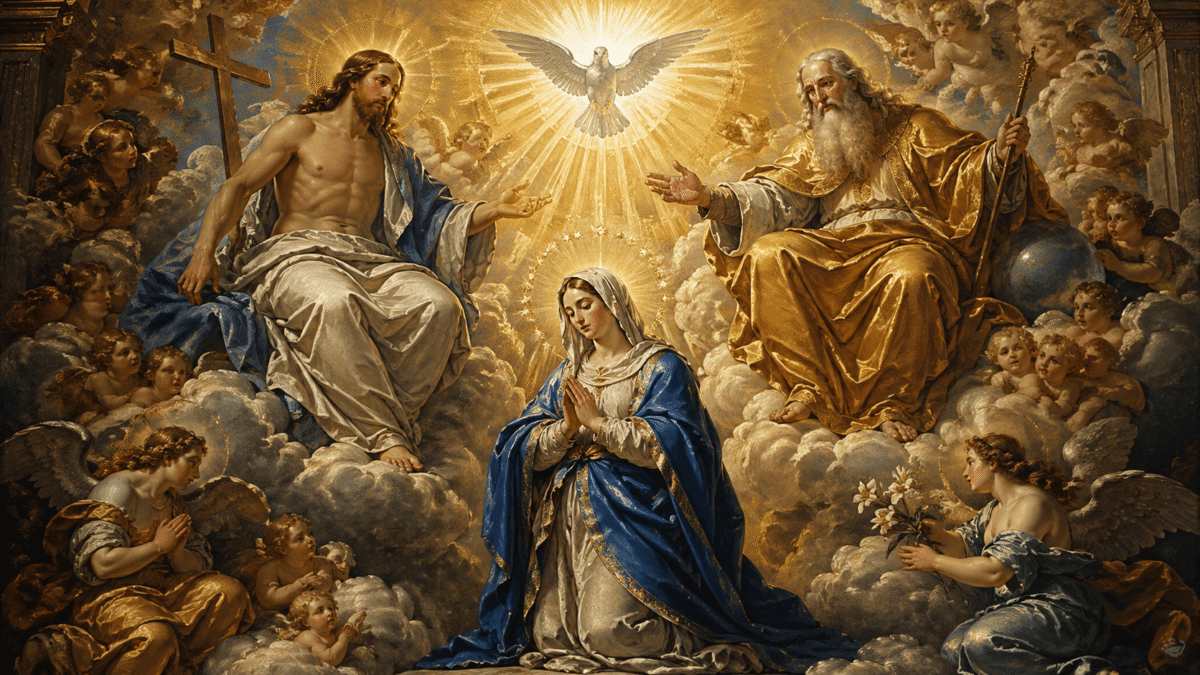
Introdução
The Trinity is the most comprehensive theological context for understanding Mariology. Mary, as a unique creature, maintains a personal relationship with the three Divine Persons: she received maternal fecundity from the Father, gave birth to the incarnate Son, and welcomed the Holy Spirit as the power of the Most High. For a complete study, consult the article Mariology.
Duas Modalidades Teológicas
A teologia trinitária ocidental divide-se em duas “modalidades”:
- Latino-ocidental: Esta abordagem parte da essência divina como realidade anterior às Pessoas, atribuindo a cada Pessoa características comuns à divindade.
- Greco-patrística: Ao contrário, esta modalidade começa pelas Pessoas como ponto de referência para toda reflexão teológica. Ela permite uma teologia mais pessoal e relacional. Para a mariologia, a modalidade greco-patrística é considerada mais rica, pois permite considerar as relações de Maria com cada Pessoa divina de forma distinta e não apenas através de “apropriações”.
A Escola Francesa de Espiritualidade
Cardinal Pierre de Bérulle (1575-1629) initiates a profound Trinitarian mariology. For Bérulle, Mary’s divine motherhood “imitates” the Father’s paternity and “participates” temporally in the fecundity of the First Person. His followers, such as Condren, Gibieuf, Olier, Saint John Eudes, developed these ideas. Gibieuf wrote: “God, having designed from all eternity to come out of Himself along the path of love, first chose a spouse and an aid that would be like unto Him. And He thought of Mary.” Saint Louis Marie Grignion de Montfort summarizes the tradition: “God the Father communicated to Mary His own fecundity, to the extent that a simple creature is capable, in order to give her the power to generate His Son.”
Elaboração Sistemática
Trinitarian mariology proposes an analogy of the supernatural being based on the Trinity. The “maternal being” of Mary occupies a unique and irreducible place in this analogy: it is neither a grace of filial adoption (proper to adopted children) nor a grace of hypostatic union (exclusive to Christ), but a proper grace that makes her a “partner” of the Father in the temporal generation of the Son. The spiritual motherhood of Mary must also be understood trinitarily: she is fruitful in relation to the Father, who communicates to her the capacity to generate the children of adoption. The Holy Spirit actively dwells in Mary, spreading the spirit of filiation in the hearts of the faithful.
Títulos Trinitário-Marianos
A tradição patrística invocou Maria com títulos que refletem suas relações com as três Pessoas:
- “Filha do Pai”, no sentido de sócia da fecundidade paterna.
- “Comparternalis Patri” (Dionísio Cartusiano).
- “Mãe do Filho”, título central e mais rigoroso, fundamento de toda a mariologia.
- “Esposa do Espírito Santo”, indicando a ação criadora da terceira Pessoa na conceção virginal.
The contemporary theological reflection emphasizes the use of these titles with sobriety, prioritizing real relationships over nominal appropriations.
Espiritualidade Trinitário-Mariana
The Apostolic Exhortation Marialis Cultus (Paul VI, 1974) establishes the Trinitarian note as an essential characteristic of the renewed Marian devotion: “It is fitting, first and foremost, that exercises of piety toward the Virgin Mary clearly express the Trinitarian and Christological note” (n. 25). The same document calls for appropriate devotion to the Holy Spirit in Marian devotion (n. 26). The presence of the three Persons in Mary, her association with the Father’s fecundity, motherhood in relation to the Son, and active dwelling of the Spirit, is the foundation of a deep contemplative and ecclesial Marian spirituality.
Aprofundamento dos Estudos
Explore Mariologia, Teologia Mariana, Mãe de Deus e a Pós-Graduação em Mariologia.
Magistério da Igreja
Beata Virgo Maria ab aeterno a Patre electa, Spiritu Sancto obumbrata ut Filium conciperet: tota eius vita ad Trinitatem refertur et in ea comprehenditur.
Concílio Vaticano II, Const. Dogm. Lumen Gentium, n. 56
The Blessed Virgin Mary was chosen by the Father from eternity, overshadowed by the Holy Spirit to conceive the Son: her entire life refers to the Trinity and is understood within it.
Filia electissima Patris et sacrarium Spiritus Sancti, dono sublimis gratiae prae ceteris creaturis, Filium Dei carne induit.
Concílio Vaticano II, Const. Dogm. Lumen Gentium, n. 53
Beloved daughter of the Father and sanctuary of the Holy Spirit, by a gift of sublime grace above all other creatures, she clothed with flesh the Son of God.
Graduate Studies in Mariology
Wishing to deepen your formation in Mariology? Discover the Graduate Studies in Mariology from Locus Mariologicus, an academic formation that combines theological rigor, spiritual life, and the living tradition of the Church.
Learn about what the Church teaches on Mary as Mediator of all Graces.
Would you like to study Mariology seriously?
This article draws on the works of the Locus Mariologicus library. The Postgraduate Programme in Mariology takes you to the same sources with academic guidance: Scripture, the Church Fathers and the Magisterium, from the first dogma to contemporary questions.
Responses