Mary, the Great Voyager: Mary and Christ’s Peace in the Storm

Citação Bíblica e Reflexão Mariológica
“Ego sum, nolite timere.” (Jo 6,20)
This biblical text, taken from Jesus’ discourse after the miracle of the loaves and fishes, is the central point of a rich theological reflection on faith, tribulation, and the role of Mary as a model of perseverance. The interpretation that follows explores the implications of this passage, highlighting the importance of the figure of Mary in Christian tradition.
O Mar, a Noite e o Caos
In the biblical and patristic cosmology, the sea represents chaos, threat, and uncontrollable force. Psalm 107 (23-24) sings of the Lord’s majesty over the waters, while the book of Job describes the sea as the domain of Leviathan, a creature that can only be controlled by God. The Apocalypse, in turn, anticipates a future without chaos, stating that “the sea will no longer exist” (Rev 21,1).
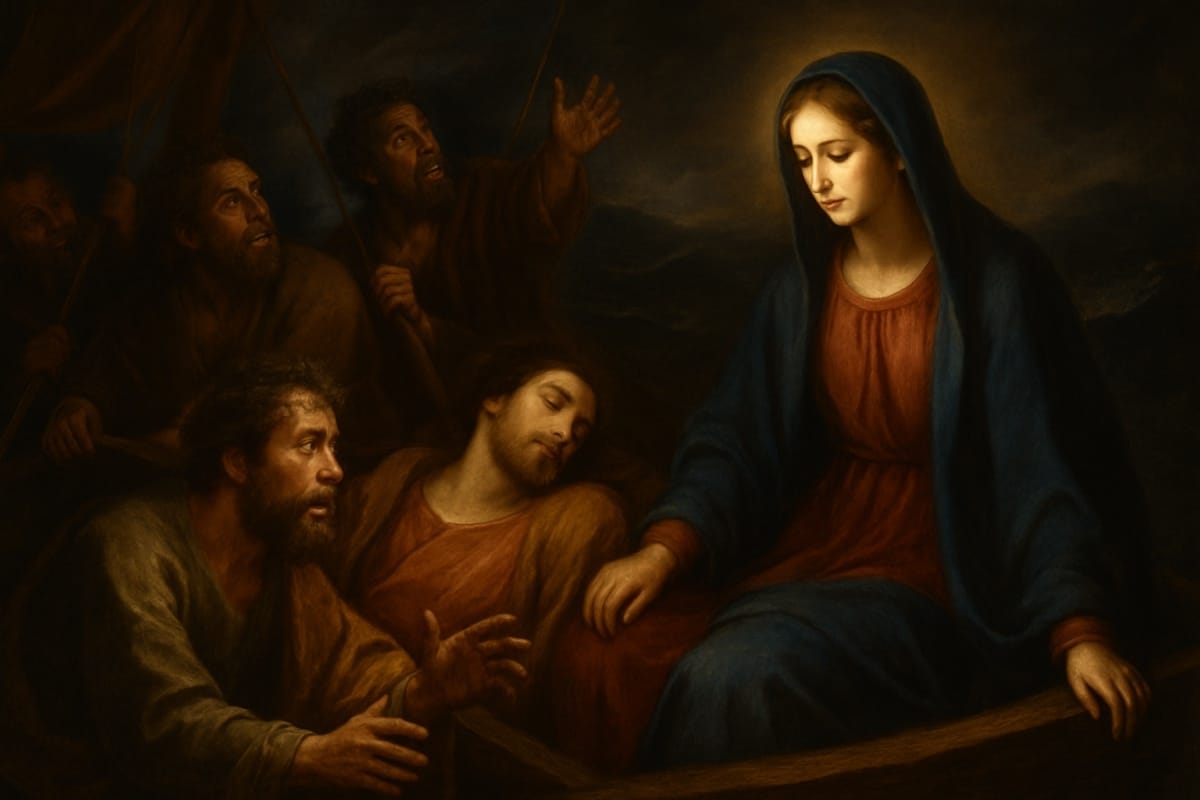
The walking of Jesus on the water is interpreted as a theophany, a divine manifestation over chaos. The night, which reinforces the symbolism of the scene, is the time of absence and temptation, as described in the Gospel of John. Mary experienced deeply this “night of faith” during Holy Saturday, when the Son was in the tomb.
“Sou eu, não temais”: Epifania Pascal
The phrase “I am” (Egō eimi) is a powerful theological expression in the Gospel of John, revealing the divine identity of Jesus. The response “do not be afraid” (nolite timere) anticipates the comfort and peace that Jesus offers. This episode about the sea reflects crucial moments in the life of Mary:
- Anunciação: Maria, ao receber a notícia de que conceberia e daria à luz o Filho de Deus, experimentou uma mistura de medo e confiança. A presença angelical que a assegurava era a prévia do “Sou eu” que Jesus diria mais tarde.
- Sábado Santo: Durante o tempo em que Jesus estava no sepulcro, Maria permaneceu na escuridão da noite, esperando pela ressurreição. Sua fé durante este período sombrio é um reflexo da paz que ela experimentaria ao ouvir as palavras de Jesus: “Sou eu”.
- Aparições pós-ressurreição: Assim como os discípulos inicialmente não acreditavam nas aparições do Ressuscitado, Maria também pode ter enfrentado dúvidas. No entanto, a repetição das palavras “Sou eu” por Jesus é o convite para uma fé receptiva e confiante.
A Estrela do Mar (Stella Maris)
The Marian tradition identifies Mary as the “Star of the Sea,” a title that emphasizes her role as a spiritual guide. The medieval hymn Ave Maris Stella expresses this idea, asking Mary to show the way to the Son. This nautical image reflects the spiritual experience of trusting in Mary during times of crisis and uncertainty.
The Marian devotion in contexts of danger at sea demonstrates the effectiveness of prayer to Mary as a source of comfort and protection. The receptive faith, which welcomes the presence of Christ without questioning, is the idealized model in the Marian tradition.
Fé Receptiva e Modelo Eclesial
The ecclesiology of the Second Vatican Council describes the Church as “the people of God on the way,” emphasizing the journey of faith. Mary, as the “type of the Church,” represents this receptive and pilgrim faith. Her ability to welcome the Lord into her heart and womb is a model for the Church, which must always be ready to receive the presence of Christ.
The paschal faith, described as an embrace of the Risen One, reflects the essence of Christian life. Mary, by being the first to welcome the Risen One in the Annunciation, continues to be the permanent model of this receptive faith that the Church must imitate.
Conclusão:
The biblical quote “Ego sum, nolite timere” invites believers to find comfort and peace in the presence of Jesus, even in life’s storms. Mary, as the Star of the Sea, guides us with her receptive and confident faith, always pointing to the Risen One who says: “It is I, do not be afraid”.
Graduate Studies in Mariology
Wishing to deepen your formation in Mariology? Discover the Graduate Studies in Mariology from Locus Mariologicus – an academic formation that combines theological rigor, spiritual life, and the living tradition of the Church.
Would you like to study Mariology seriously?
This article draws on the works of the Locus Mariologicus library. The Postgraduate Programme in Mariology takes you to the same sources with academic guidance: Scripture, the Church Fathers and the Magisterium, from the first dogma to contemporary questions.
Responses