Let children come to me: St. Dominic, the Rosary, and Mary, Mother of the Little Ones
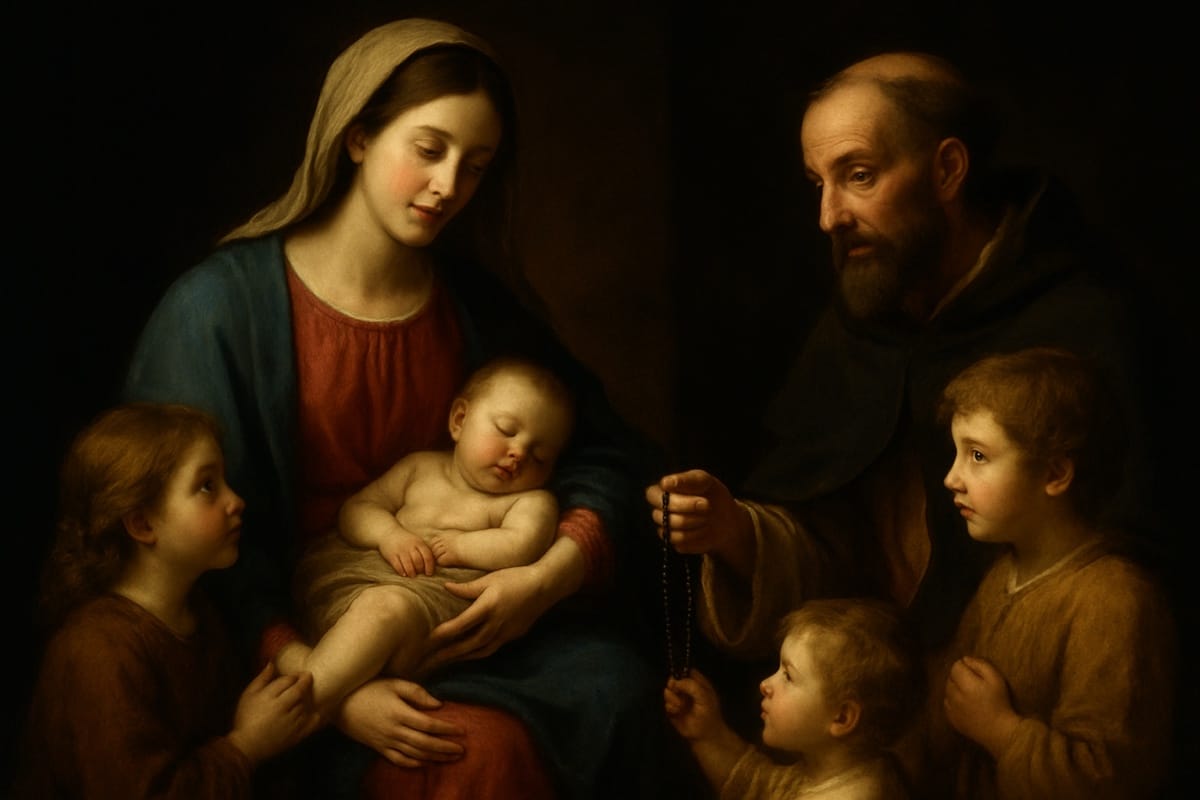
Quote:> “Let the children come to me and do not hinder them, for such is the kingdom of heaven.” (Matthew 19:14)Paragraphs:This brief episode in Matthew 19:13-15, while concise, is rich in meaning. When children are brought to Jesus for a blessing, the disciples rebuke those who bring them, only for Jesus to chide his disciples and accept the children. “Let the children come” (sinite parvulos) is not merely pastoral instruction on infant catechism; it reinforces the principle from Matthew 18:3 (“Unless you turn and become like children, you will not enter the kingdom of heaven”). The children are not a social group that Jesus welcomes out of human sympathy; they represent the way to receive the Kingdom he has been teaching since the beginning of his ecclesial discourse.August 8th celebrates the Feast of Saint Dominic (1170-1221), founder of the Order of Preachers (Dominicans) and a central figure in the history of Marian devotion, especially that of the Rosary. The liturgical coincidence between “Let the children come” in Matthew 19:14 and the feast of the founder of the Rosary is theologically rich: the Rosary is precisely a way to “let the Lord come,” not through the force of theological reasoning but through simple and repetitive contemplation of Jesus’ mysteries with Mary’s eyes, “like children.”I. “Let the Children Come”: The Kingdom of Those Who Have Nothing“Do not hinder them from coming to me” (μὴ κωλύετε) is a technical verb in the baptismal tradition: the same verb used by the Ethiopian eunuch when he asks Philip, “What prevents me from being baptized?” (Acts 8:36), and by Peter when he declares, “Who can prevent these from being baptized?” (Acts 10:47). The phrase “let the children come” foreshadows baptismal theology: children receive baptism precisely because their inability to earn it is the model of grace; they are baptized not to gain salvation but to receive it as children.“For such is the kingdom of heaven” (talium est enim regnum caelorum) refers not to greatness but to resemblance. This “resemblance” is not chronological (being young) but dispositional: openness without resistance, acknowledged dependence, and an inability to stand on one’s own that disposes one to receive. “Such is the kingdom of heaven” is the key to Jesus’ entire pedagogy about the Kingdom; it is not the strong who deserve the Kingdom, but “the Kingdom belongs to those who are like children.”The laying on of hands with which Jesus blesses the children (Matthew 19:15) is a prophetic gesture, the same used in ordination, confirmation, and anointing of the sick. When Jesus lays his hands on the children, he does not treat them as objects of pity but as subjects of blessing; he imparts to them a grace that adults need to regain. The child who receives Jesus’ blessing is paradoxically the one who conveys the most essential message of the Kingdom to “the adults” who brought them.II. Saint Dominic and the Rosary: Contemplating Like ChildrenDominic of Gusman was born in Caleruega (Castile) in 1170 and founded the Order of Preachers in 1216, dedicated to preaching through poverty, prayer, and study. His figure is inextricably linked to the Rosary: Dominican tradition attributes to Dominic the reception of the Rosary from Our Lady as a “weapon” against Albigensian heresy in southern France. While the historicity of this tradition is debated, the role of Dominicans in spreading and codifying the Rosary is undeniable: St. Louis de Montfort, St. Pius V (who attributed the victory at Lepanto to the Rosary), and Blessed Álvaro of Córdoba were all Dominicans.The Rosary as a contemplative practice is the adult equivalent of “sinite parvulos”: a prayer that requires no theological erudition, no advanced intellectual capacity, repeating the same simple words (Ave Maria) while the heart contemplates the mysteries of Jesus. This structure—external repetition that liberates inner attention for contemplation—is precisely the “logic of a child” described in Matthew 19:14: availability that is not won but received, not formulated but contemplated, not demonstrated but simply “abides” with Jesus and Mary.
III. Mary and St. Dominic: Preaching Arising from Contemplation
Dominican spirituality has a formula that encapsulates Dominic’s vocation: “contemplata aliis tradere,” to transmit to others what was contemplated. This formula, in its deepest structure, is the formula of Mary’s spiritual motherhood: she who “contemplated and kept in her heart” (Luke 2:19) and “transmitted” through her presence and intercession what she had contemplated. The Order of Preachers founded by Dominic looks to Mary as its contemplative model, not just as a devotional protector but as a pedagogue prioritizing contemplation over action.Dominic’s relationship with Mary is documented in his hagiography: his mother, before his birth, saw a dog with a torch leaping from her breast, illuminating the world—a prophetic image of the preacher who would illuminate the Church. Dominic saw Mary as the Queen of Preachers, the one who “announced” the Gospel to Elizabeth during the Visitation (which she preserved to transmit), and who at Cana anticipated the public ministry of the Son. The Rosary that Dominic spread is, in this sense, a school of “contemplata tradere”: contemplating the mysteries with Mary to transmit them through witness in life.The “sinite parvulos” of Matthew 19:14 applied to Dominican spirituality reveals the paradox of Christian preaching: the most effective preaching arises not from erudition but from simple contemplation, “being like a child” before the mysteries of Jesus. Dominic, who studied theology rigorously, did not preach from his erudition but from prayer. His “seven modes of prayer” (documented in Dominican tradition) were all forms of “sinite parvulos,” allowing body and soul to open to the Lord without complicated mediations.IV. Mary, Mother of the Little Ones: Saturday as a Memorial of Her Protection
This Saturday is also, in traditional devotion, the Blessed Virgin Mary’s Saturday, a weekly memory of Mary that dates back to the Middle Ages and which the liturgy preserves as an optional “memory” on Saturdays without a proper feast. The coincidence of the Marian Saturday with the feast of St. Dominic and the Gospel of “let the little children come” creates a coherent devotional context: Mary who protects the little ones (Blessed Virgin Mary Saturday), who teaches us to contemplate like children (Dominic’s Rosary), and who intercedes for those who “come” to her Son (Mt 19:14).Mary’s protection over the “little ones” is a theme that runs through Marian devotion from the “sub tuum praesidium” (3rd century) to contemporary popular devotions. Mary as the “Mother of the Poor” (Our Lady of Fátima), “Mother of the Humble” (Magnificat), and “Mother of Children” (devotion to Our Lady of Perpetual Help) are different facets of the same theological reality: she who gave birth to the Son who said “let the little children come” is the mother of all who come to him as children.The Rosary that St. Dominic spread and the Church confirmed as a privileged form of Marian prayer is, in essence, a “let the little children come” prayed: a prayer that embraces Jesus’ mysteries as a child embraces the present, without analyzing or demonstrating it, simply receiving it with gratitude and joy. Praying the Rosary with Mary is doing what Jesus asked: “let the little children come” to the Lord, without the obstacles of adult self-sufficiency, with the openness of one who knows that “of the Kingdom of Heaven, it is those like them who belong.”Post-Graduate Studies in Mariology
Would you like to deepen your formation in Mariology? Discover the Master’s Degree in Mariology from Locus Mariologicus – an academic formation that combines theological rigor, spiritual life, and the living tradition of the Church.
Would you like to study Mariology seriously?
This article draws on the works of the Locus Mariologicus library. The Postgraduate Programme in Mariology takes you to the same sources with academic guidance: Scripture, the Church Fathers and the Magisterium, from the first dogma to contemporary questions.
Responses