Pseudo-Dionysius Areopagita – On the Celestial Hierarchy: The Nine Choirs of Angels
Author and Work
Author: Pseudo-Dionysius Areopagita (anonymous Syrian author of the 5th-6th centuries, mistakenly identified with Dionysius Areopagita converted by St. Paul in Acts 17:34)
Work: De caelesti hierarchia (On Heavenly Hierarchies)
Original Language: Greek
Period: Likely around 500 AD, in Syria
Magisterial Status: Recognized by Church Tradition, though the apostolic attribution is erroneous.
Historical Background of Attribution
The author introduces himself as “Dionysius” who was converted by St. Paul at the Areopagus in Athens (Acts 17:34). This attribution was accepted until the Renaissance, but today it is recognized as a pseudonym. The actual author is probably a Syrian monk from the late 5th century (around 500 AD), influenced by Neo-Platonist philosophy, particularly that of Proclus (412-485). The discovery of the false attribution (by Lorenzo Valla in 1457 and Erasmus of Rotterdam) did not diminish its theological authority; the Church Magisterium acknowledges its teachings as authentically Catholic.
Structure of De caelesti hierarchia
The treatise consists of 15 chapters organized around three main themes:
- Chapters 1-3: General principles about angels as divine messengers.
- Chapters 4-9: Description of the three hierarchies and the nine choirs.
- Chapters 10-15: How angels relate to humans and the cosmos.
The Three Hierarchies
Pseudo-Dionysius organizes angels into three hierarchies, each with three choirs:
I. First Hierarchy (Supreme) – Chapter 7
“The first hierarchy is closest to divine primacy and is the first to participate in the direct illumination of God.”
- Seraphs (Hebrew: seraphim, “burning ones”): Contemplate God’s divine love directly.
- Cherubims (Hebrew: kerubim): Possess the fullness of divine knowledge.
- Thrones: Unchanging adherence to God’s presence.
II. Second Hierarchy (Intermediate) – Chapter 8
“The second hierarchy receives light from the first and transmits it to the third.”
- Dominations (Greek: kyriotetes): Rule over lower hierarchies.
- Virtues (Greek: dynameis): Cosmic power, perform miracles.
- Powers (Greek: exousiai): Govern hierarchies.
III. Third Hierarchy (Lower) – Chapter 9
“The third hierarchy is closest to the world of men, ministering in God’s providential actions.”
- Principates (Greek: archai): Govern peoples and nations.
- Archangels (Greek: archangeloi): Serve as messengers for great deeds.
- Angels (Greek: angeloi): Personal messengers.
Greek Text – Chapter 7 (Excerpt)
Translation:
“We examine the celestial hierarchical orders, declaring that the most proper and theologically first order is the sacred constellation of Seraphim, Cherubim, and Thrones.”
The Three Characters of the Celestial Hierarchy
Pseudo-Dionysius defines that every angelic hierarchy has three characters:
- Purification (katharsis): freeing oneself from all imperfection
- Illumination (photismos): receiving divine light
- Perfection (teleiosis): union with the source of good
These three moments are also characteristic of the human ecclesiastical hierarchy: hence its influence on sacramental theology and monastic life.
Historical Reception
Patristic and Byzantine
- St. Maximus Confessor (7th century): First great Greek commentator on Pseudo-Dionysius
- St. John Damascene (8th century): Integrates his theological synthesis
- Patriarch Fekios (9th century): Recognizes the authority of the treatise in the Byzantine Church
Medieval Latin
- John Scotus Erigena (9th century): First Latin translation
- St. Bernard (12th century): Extensively uses it in his mystical works
- St. Hugh of St. Victor (12th century): First great Latin commentator
- St. Thomas Aquinas (13th century): Integrates it into the Summa Theologica and founds the scholastic angeological system
- St. Bonaventura (13th century): Develops the mystical strand
- Meister Eckhart (14th century): Speculative mysticism based on Pseudo-Dionysius
Recent Magisterium
- Roman Catechism (1566): Adopts the Dionysian hierarchy
- CCC (1992): Mentions implicitly the nine choirs (n. 330)
- Liturgy of the Hours: The Vespers hymns (especially those of Friday) frequently refer to the nine choirs
Theological Meaning
The work of Pseudo-Dionysius answers two major questions in angelology:
Why the number “nine”?
Three triads of three: a Trinitarian structure multiplied by itself. The number nine symbolically represents divine fullness. The nine choirs reflect the Trinity in spiritual creation.Why does the angelic hierarchy exist?
To participate in God’s gift in various degrees: the closer to God, the more perfectly one receives divine illumination. Hierarchy is not domination but a service of illumination.
Pseudo-Dionysius in Christian Iconography
The nine angelic choirs were codified in Christian iconography based on Pseudo-Dionysius:
- Serafins: six wings, red, burning
- Cherubim: blue, holding books (wisdom) or with wings covering their bodies
- Thrones: figures with wheels (Ezequiel 1)
- Dominions: holding sceptres
- Virtues: with auras, ethereal forces
- Principates: in weapons, protection
- Archangels: winged, young armed (especially Michael, Gabriel, and Raphael)
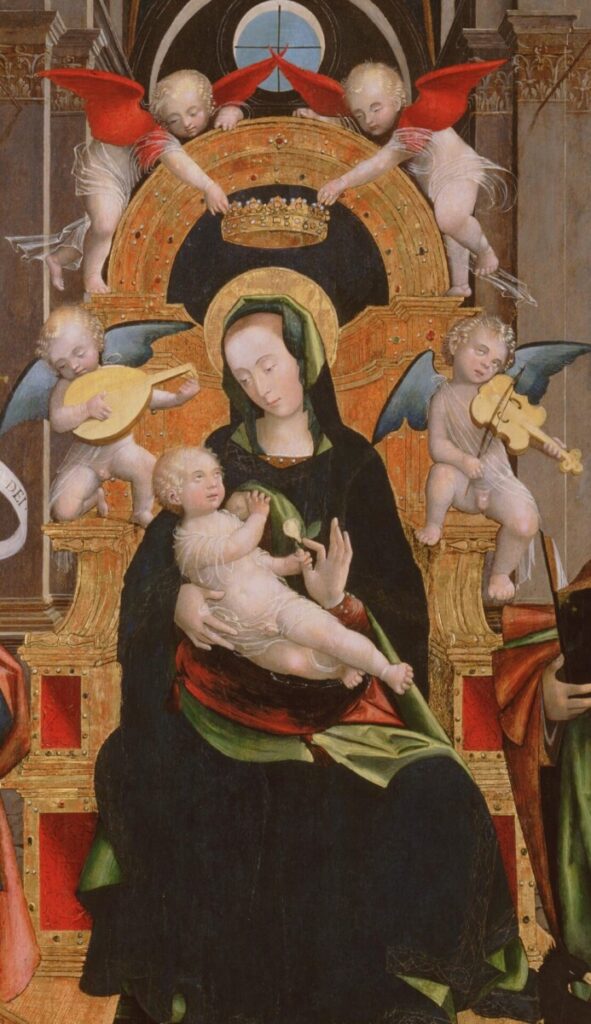
- Angels: winged, dressed in white tunics
Recommended Reading
St. Thomas – Treaty of Angels (Summa Theologica, 50-64) | St. Michael | St. Gabriel | St. Raphael | Guard Angels
Master’s Degree in Mariology
Want to deepen your formation in Mariology? Learn about the Master’s Degree in Mariology from Locus Mariologicus – an academic formation that combines theological rigor, spiritual life, and the living tradition of the Church.
Would you like to study angelology with academic rigour?
This article draws on the works of the Locus Mariologicus library. Angelology is one of the subjects of the Postgraduate Programme in Mariology, within a 360-hour curriculum ranging from Scripture to the Church Fathers and the Magisterium.
Responses