Mary at the Wedding of Cana
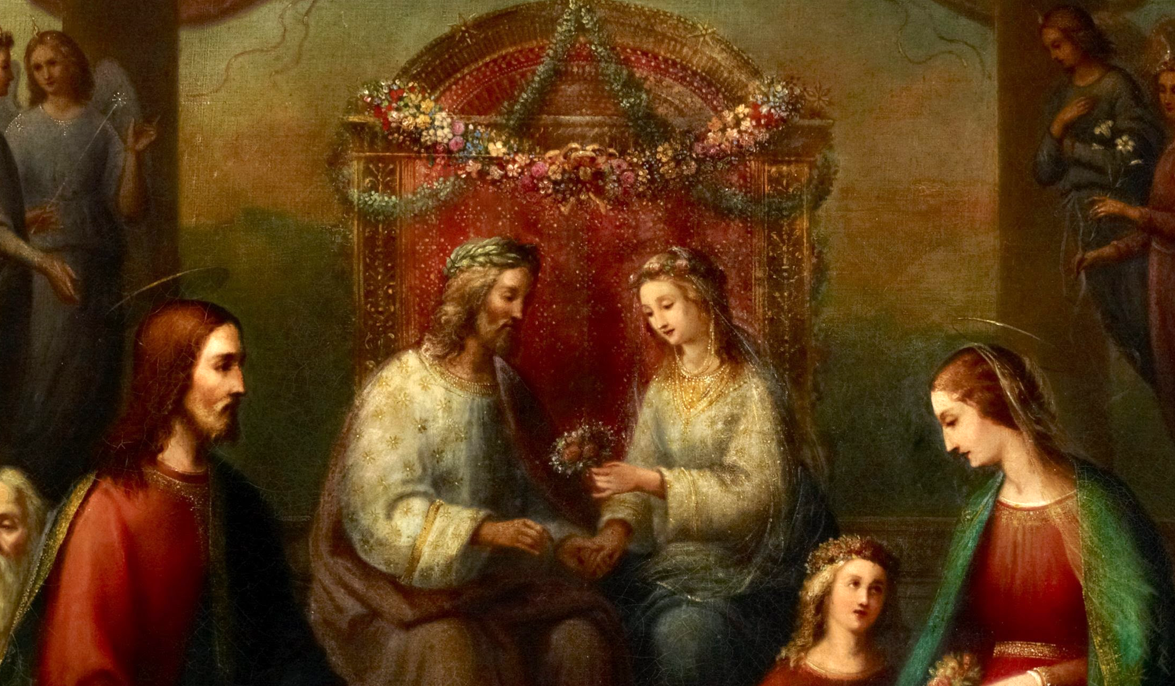
The Johannine literature, the latest and most mature of the New Testament, is particularly rich in theological reflection. In it, more than anywhere else, the narrative serves the message. This does not mean that the Johannine writings do not address history, but rather that it is a “symbolic-sacramental” history that at the same time conceals and reveals highly spiritual realities.In the humility of the events of this world, divinity made its entrance (“the Word became flesh”) and reality was invested and transfigured by the glory of God. Events, actions, gestures, and characters present a strong Christological orientation: they are at the service of the revelation of the Son of God. In this light, the figure of Mary must also be considered.The Johannine tradition, unlike what happens in Luke, is quite sober, quantitatively speaking, regarding Mary: it speaks of her only at the beginning (in Cana) and at the end of the Gospel (at the Cross) and indirectly in Revelation 12. But, at least as far as the Gospel is concerned, one can say that quantity is inversely proportional to quality: in both episodes, those of Cana and the Cross, we reach the pinnacle of reflection on Mary in the New Testament. She is no longer merely the faithful one and the mother of Jesus, but precisely because she is faithful and a mother, she is placed at the beginning and the end of the Gospel, at the service of the faith and life of the Lord’s disciples. In this way, she is directly and uniquely involved with the person and work of the Son.Jn 2,1-11 is a passage that has been studied over time but still holds mysterious riches, almost inexhaustible. It is a fundamental episode not only for understanding the figure of Mary but primarily for delving into the heart of the Gospel of John, in its message and, in particular, in its Christology. After the crucial initial chapter, which includes the prologue hymn (1:1-18) and the narrative prologue (1:19-51) with the testimony of John the Baptist about Jesus and the calling of the first disciples (all marked by a precise sequence of days and hours, important to the evangelist), right in the next chapter, we find the presence of Jesus’ mother. The episode at Cana does not primarily concern Mary, although she is deeply embedded within it. On the contrary, precisely because she is “embedded” in the revelation of the mystery of Jesus, among grand theological-salvific realities, the figure of the Virgin acquires a singular prominence. This becomes more evident when we compare the scene at Cana with that of Mary at the cross.As “woman“, Mary has a mission, in continuity with the ancient Daughter of Zion, at the service of all the people of God, but this will become clearer in the scene of Calvary. The mother of Jesus, finally, through her faith, is the first of the Lord’s disciples, those who, upon receiving the word of Jesus, constitute the community of the new covenant. She, together with the disciples who have become faithful, is the true bride of Him who, beyond symbols, is the spouse of the Church and humanity: Jesus, the Word of God made flesh.Regarding Mary’s role at the Wedding of Cana and her maternal intercession, refer to Pope John Paul II’s Encyclical Redemptoris Mater.
Post-Graduate Program in Mariology
Want to deepen your formation in Mariology? Discover the Post-Graduate Program in Mariology from Locus Mariologicus – an academic formation that combines theological rigor, spiritual life, and the living tradition of the Church.
Would you like to study Mariology seriously?
This article draws on the works of the Locus Mariologicus library. The Postgraduate Programme in Mariology takes you to the same sources with academic guidance: Scripture, the Church Fathers and the Magisterium, from the first dogma to contemporary questions.

Responses