Mary and the Word of God, person and event
Spotify Embed: Podcast #127 – Mary and the Word of God, Person and Event
Mary and the Word, Person and Event
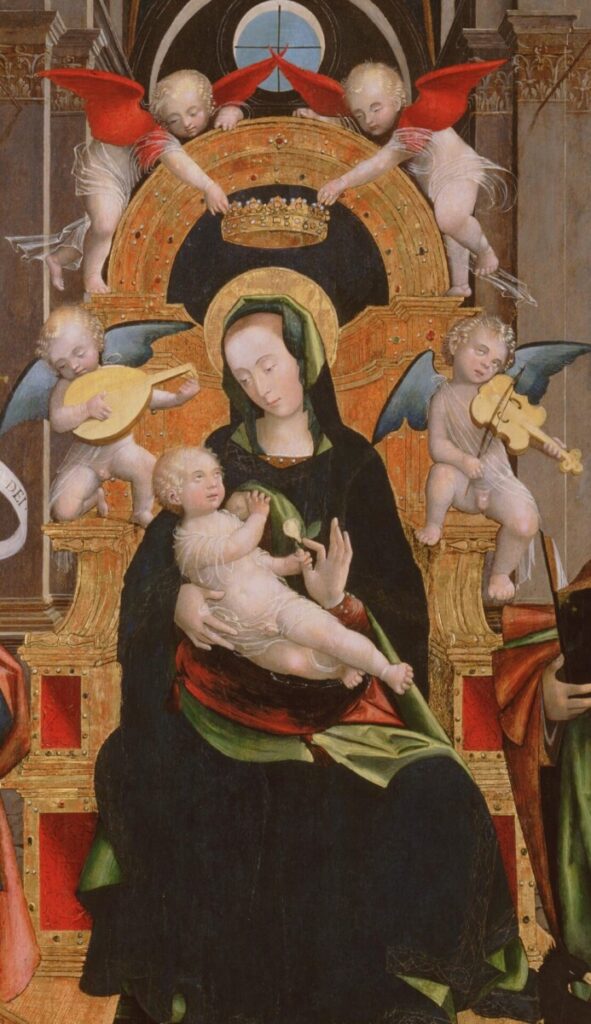
The meaning of this approach invites us to avoid crafting a theology of the Word and then applying it to Mary. Instead, we must ask ourselves what the Word meant in the life and personality of this woman.
The simplest way to establish a relationship between Mary and the Word is to spend a few moments clarifying both. It goes without saying that Mary can only be approached through her history and life. In fact, we know very little about her in a biographical sense.
Some authors have attempted to gather historically what can be said about Mary: comparing passages from Mark 3:31-35, Galatians 4:4, Luke 11:27-28, and John 2:12, and Acts 1:14. They reached some conclusions that can be easily summarized: Mary is a Hebrew woman presented in the Gospels alongside Jesus and part of a family group, Jesus’ brothers, who played a role both during the pre-Paschal period and in the post-Paschal community, although this role was relativized in the Gospels in favor of the twelve and the disciples.
These conclusions are obvious. It is worth recalling the fundamental data from the Gospel that presents Mary as “the mother of Jesus.” The soberness of the biblical narrative derives from its midrashic style, meaning that the account often assumes a richness of symbolism aimed at illuminating the event and offering a preliminary interpretation. These symbols can enrich our understanding of Mary, but they should not obscure the concrete reality of her history. Mary is not a myth or symbol but a specific person:
Mother of Jesus!
Midrash
Midrash is a method of Jewish exegesis that developed after the Babylonian exile. Its purpose was to construct associations and applications from a biblical text that went beyond its literal meaning. The Hebrews distinguished two types of midrash: midrash Halakhah (Heb. way), which focused on oral law, and midrash Haggadah (Heb. narration), which tended to clarify non-legal sections of the Bible.
Upon reaching a conclusion regarding the historicity of the Mother of Jesus, we now turn to the Word. It can be said that this is an abstract term serving as a reference to something concrete: God’s Word refers to God speaking. The Hebrew word dabar, word, initially does not refer to a teaching or doctrine but to an event. We can describe God’s Word as an act, language, and mystery. As an act, the Word is God’s action, meaning it is the divine acting. The transcendence of divine action ensures that His Word, upon entering history, remains divine and retains its unique creative power. On the other hand, its submission to history means that, under the human aspect, the unchanging and eternal Verbal is expanded and manifested in different times: there is the Creator’s Word, Moses’ revelation at Sinai, the prophetic Word, the wisdom of the sages, the Word made flesh in Jesus, Kerygma, and the testimony of the Church. And there is also Mary’s story.
As an act of God, the Word is an event for all, a meeting, and retains the power of a revelation. Therefore, Paul reminds the Corinthians in 1 Corinthians 2:4 that his language was not based on “my word and my preaching did not consist of persuasive words of human wisdom, but in demonstration of Spirit and power.” Besides being an act, the Word is also language and, as such, expresses God’s intent and His inner world: through the Word, the source of love from which trinitarian life and salvation flow is expressed.
Thus, God’s Word cannot be reduced to a script occasionally inspired by God, for it is much more than that. The Scriptures have a revelatory and educational task because, illuminating hearts like a two-edged sword, they separate what should be separated.
As Escrituras como Mistério e o Envolvimento de Maria
As mystery, the Word of God constantly refers to its divine origin and the purpose that God intends to convey. However, there is an element of concealment in the Word: it does not always reveal itself clearly but often assumes profane forms, communicating wisdom for life or religious or social choices that may be controversial. Thus, the Word hides its divine origin by exposing both the scandal of the Nazarene with their fellow countryman Jesus and Peter’s reluctance to understand the mystery of the cross. Overcoming this human appearance and discerning its divine origin is not an easy task; only through faith can the Word be recognized in its truth. Therefore, Jesus, when commenting on Peter’s faith, reminds him: “Neither flesh nor blood revealed this to you, but my Father who is in heaven” (Matthew 16:17).
For a deeper reflection on Mary and the Word of God, consult John Paul II’s Encyclical *Redemptoris Mater*, which contemplates Mary as the one who received and incarnated the divine Word in a unique and perfect manner.
Profundidade nos Estudos:
Explore Mariologia, Teologia Mariana, Aparições Marianas e a Pós-Graduação em Mariologia.
Would you like to study Mariology seriously?
This article draws on the works of the Locus Mariologicus library. The Postgraduate Programme in Mariology takes you to the same sources with academic guidance: Scripture, the Church Fathers and the Magisterium, from the first dogma to contemporary questions.

Responses