Iconography of Mary: Priscilla’s Catacombs, The Announcement
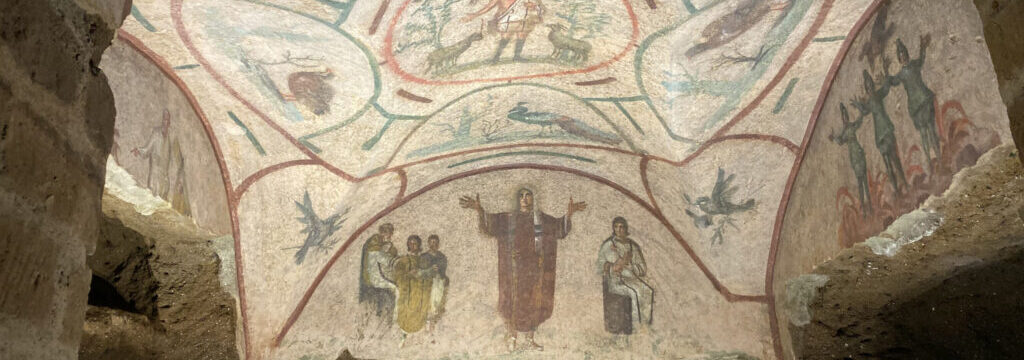
TL;DR – Summary. The Annunciation depicted in the Catacomb of Priscilla (3rd century, Rome) is the oldest known Marian image in Christian art. Mary is portrayed as a Roman matron seated, receiving the announcement from an ungainly angel—a primitive iconographic type. The image attests to Mary’s centrality in early Christian faith even before the Dogma of Theotokos (Council of Ephesus, 431).
Key Points
- The Catacomb of Priscilla (Via Salaria, Rome) contains the first documented Marian iconographic representation (3rd century).
- The scene of the Annunciation occupies the center of a cubicle ceiling, with Mary on the left as a veiled Roman matron.
- The angel is depicted without wings—the oldest iconographic type, predating Byzantine influence.
- The image precedes by over a century the conciliar definition of Theotokos at the Council of Ephesus (431).
- Its central location in the dome, shared with scenes of Jonah and the Good Shepherd, attributes to the Annunciation theological significance as a key image of salvation.
The Marian iconography, especially the primitive representations, offers a fascinating window to understand the devotion and Christian theology of the early centuries. Here are some frequently asked questions and answers about primitive Marian iconography:
1. O que é a “Virgem com o Menino”?
The “Virgin with the Child” is one of the most common representations of the Virgin Mary in early Christian art. This image depicts Mary holding Jesus, often referred to as the “Child” or “Infant,” in her arms. It symbolizes Mary’s divine motherhood and her unique relationship with the Son of God.
2. Quem são as figuras frequentemente retratadas ao lado da Virgem e do Menino?
In the earliest representations, the Child Jesus is often accompanied by saints or angels. For example, in Byzantine art, it is common to see Saints Joseph, John the Baptist, or other saints near the Virgin and the Child. These figures represent the community of believers and their participation in the life and mission of Jesus.
3. O que representa a “Estrela” ou “Espada” na iconografia mariana?
The star or sword is a frequent symbol associated with the Virgin Mary. In art, she is often depicted with a sword piercing her heart or holding a star. These symbols have various interpretations:
– Star: Represents hope, guidance, and the royalty associated with the Virgin. In Christian tradition, Mary is seen as the “Star of the Sea” (Revelation 22:1), guiding believers to salvation.
– Sword: Symbolizes the sacrifice and pain that Mary experienced in giving birth to the Son of God. It can also represent the strength and protection she offers to her spiritual children.
4. O que é a “Virgem com o Anel”?
The representation of the Virgin with a ring is less common but significant. The ring is generally interpreted as a symbol of Mary’s power and authority, as well as her purity and holiness. This icon can be seen as a metaphor for her role as intercessor and mediator between God and humanity.
5. Como as catacumbas romanas contribuem para a compreensão da iconografia mariana?
The Roman catacombs, especially those with frescoes and murals, provide a rich set of early Marian images. These representations include scenes from the life of Mary, such as the Annunciation (the visit of the angel Gabriel), the Visitation of Saint Joseph, and the Presentation in the Temple. The frescoes in the catacombs offer insights into the devotional and theological practices of early Christians, often reflecting a more popular and accessible spirituality.
6. Qual é o significado da “Virgem com o Menino entre os Santos”?
This iconography depicts Mary and Jesus surrounded by saints, often including biblical figures such as Saint John the Baptist, Saint Joseph, and even prophets from the Old Testament. It represents the communion of saints and Mary’s inclusion in this celestial community. The saints around symbolize the universal church, both the living and the deceased, all united in worship and love for Jesus.
7. Por que a “Natividade” é uma festa importante na iconografia mariana?
The Nativity of the Lord, celebrated on December 25th, is a central event in the life of Mary and in Christian theology. The iconography of the Nativity depicts the moment when Jesus is born in Bethlehem, with Mary as His mother and Joseph as His earthly father. This image symbolizes the incarnation of Christ, uniting the divine and the human, and highlights the role of Mary in this central mystery of the Christian faith.
8. Como a arte bizantina influenciou a iconografia mariana?
The Byzantine art played a significant role in shaping Marian iconography. Byzantine icons, with their strict rules of representation (such as the “theory of proportions” and the prohibition of figurative representations of God), influenced how Mary and other saints were portrayed. Byzantine icons often feature a unique aesthetic, with calm faces and serene expressions, reflecting the spiritual and mystical nature of Byzantine art.
9. O que é a “Teofania” na iconografia mariana?
Theophany refers to the revelation of God, especially in significant moments of Jesus’ life. In Marian iconography, theophanic scenes may include the Annunciation (the angel Gabriel announcing the birth of Jesus) and the Transfiguration (Jesus revealing his divine glory to the disciples). These representations symbolize the divine presence in Mary and her son, emphasizing the divine nature of the Incarnation.
10. Como a iconografia mariana evoluiu ao longo do tempo?
The Marian iconography has evolved over the centuries, reflecting changes in theology, culture, and devotional practices. While early representations tend to be more symbolic and static, later arts incorporate more complex narrative elements. During the Middle Ages, for example, scenes from Mary’s life became more detailed, and Renaissance representations added increasing realism and emotion.
Where is the oldest representation of Mary in Christian art?
The earliest known Marian representation is located in the Catacumbas de Priscila on the Via Salaria in Rome, dating back to the third century. It is a scene of the Annunciation painted on the ceiling of a funerary cubicle, depicting Mary as a seated Roman matron and the angel Gabriel standing without wings.
Why is the angel represented without wings in the Catacumbas de Priscila?
The representation of the wingless angel corresponds to the oldest Christian iconographic type, preceding the development of Byzantine iconography. Wings only became common in Christian art from the fourth-fifth century onwards, inspired by classical models such as the Winged Victory and the Roman Genius, adapted to a new context.
What theological value does this iconography hold before the dogma of Theotókos?
The image predates by more than a century the conciliar definition of the Divine Motherhood (Ephesus, 431) and demonstrates that the early Christian community already recognized Mary as a central figure in the economy of salvation. The iconography precedes the dogma and prepares the ground for its formulation.
What other Marian scenes appear in the Roman catacombs?
In addition to Priscila’s Annunciation, the Roman catacombs contain the Adoration of the Magi (Catacumbas de Domitilla, Peter, and Marcelino), Balaam’s prophecy pointing to the Virgin (Priscila), and scenes of the Virgin with the Child. These images share Christological symbolism and are often associated with funerary contexts of eschatological hope.
Post-Graduation in Mariology
Do you want to deepen your studies in Mariology? Learn about the Post-Graduation in Mariology at Locus Mariologicus – an academic training that combines theological rigor, spiritual life, and the living tradition of the Church.
Sign up or learn more here.
See also:
Patristic Mariology: the Church Fathers and Mary (2nd-8th centuries).
Discover the oldest representation of Mary in the Catacombs of Priscilla.
Would you like to study Mariology seriously?
This article draws on the works of the Locus Mariologicus library. The Postgraduate Programme in Mariology takes you to the same sources with academic guidance: Scripture, the Church Fathers and the Magisterium, from the first dogma to contemporary questions.
Responses