Marian Iconography: The Theology and Types of Eastern Tradition

The Marian Icon as Sacramental and Expression of Faith
The marian icon in the Eastern Christian tradition is more than a work of art; it is a sacramental and channel of grace, considered on par with Scripture and Tradition as an expression of the Church’s faith. The Second Council of Nicaea (787) established the doctrine of the veneration of sacred images, distinguishing between proskynesis (veneration due to images) and latria (worship due only to God). The traditional technique is egg tempera on wood, executed in prayer and fasting: the iconographer does not “paint” but “writes” the icon.
The Tradition of Saint Luke and Its Beginnings
The Eastern tradition attributes the first portraits of Mary to Saint Luke. The Fifth Council (692) and the Second Council of Nicaea established norms for sacred iconography. The Iconoclastic Crisis (726-843) was a significant test of icon theology: defenders of icons, led by Saint John Damascene, argued that refusing to venerate images of Christ implied denying the reality of the Incarnation. The triumph of orthodoxy in 843, known as the “Triumph of Orthodoxy,” forever cemented the place of icons within the Eastern Church.
Major Types of Marian Icons
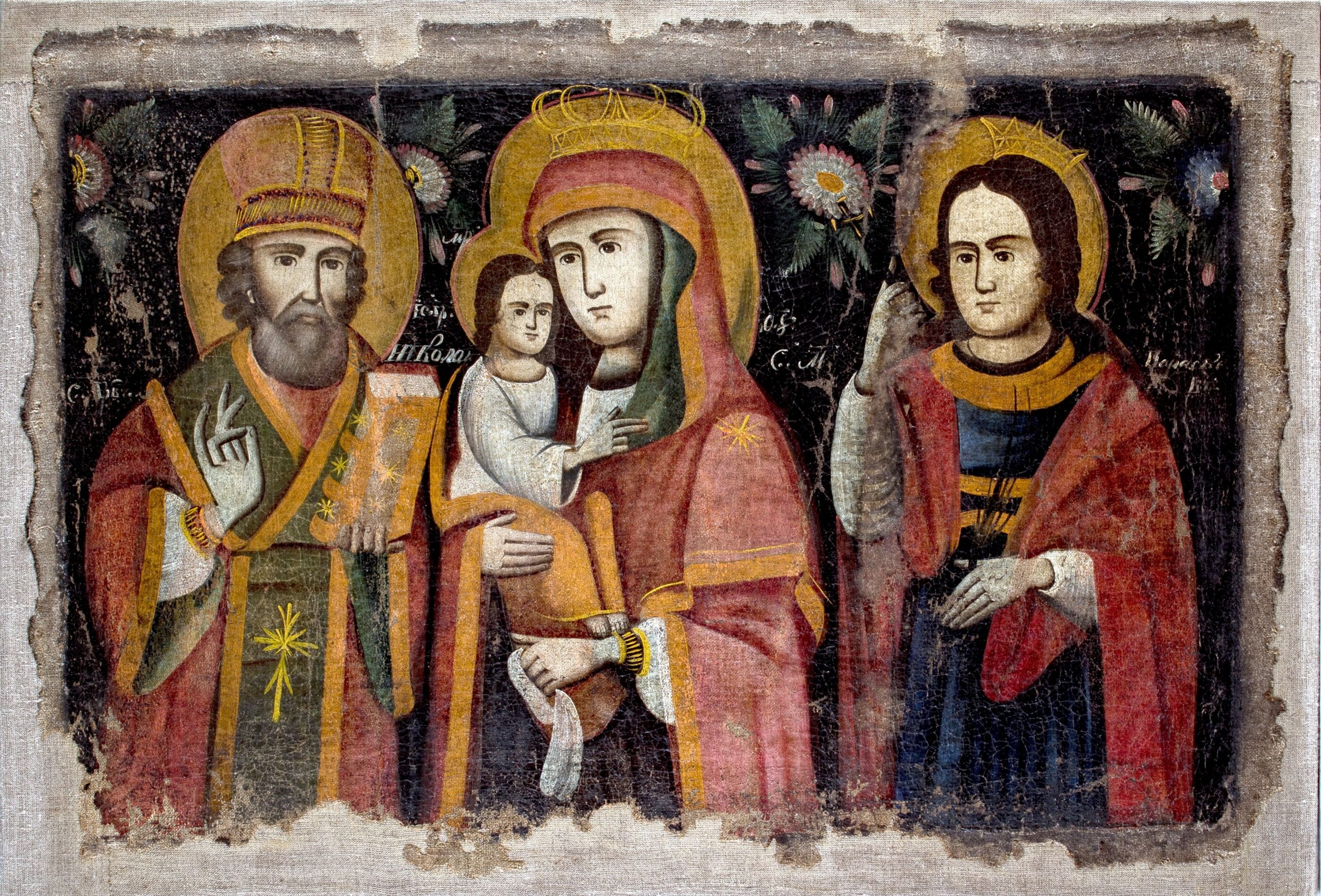
The Eastern tradition has codified major types of Marian icons. The Hodigitria (“the one who guides”) depicts Mary facing forward, pointing to Christ with her right hand: it proclaims Christ as the sole path and is the quintessential missionary icon. Attributed to Saint Luke, the original, venerated in Constantinople, was destroyed in 1453. The Eleusa (“merciful”) portrays Mary and the Child face-to-face, in a moment of intimate contact: it expresses the tenderness of divine motherhood and emphasizes Christ’s humanity. A famous example is the Madonna of Vladimir (Constantinople, early 12th century), now at the Tretyakov Gallery in Moscow.
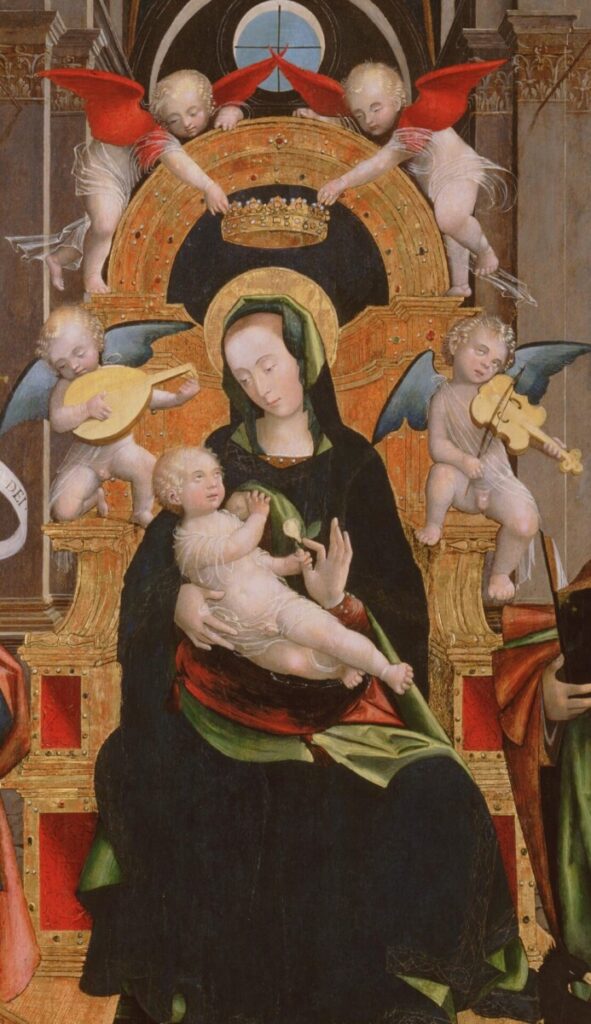
The Orante depicts Mary in a prayerful posture, with her arms raised in intercession. The Galaktotrofusa (“nursing”) shows Mary breastfeeding the Child, referencing Luke 11:27, with notable examples from Egypt in the 6th century. The Madonna of Passion, known in the West as Our Lady of Perpetual Help, portrays two angels showing the Child the instruments of His passion. A famous copy is venerated since 1865 in Rome at the Church of the Redemptorists.
The Znamenie or Madonna del Segno (also Platitera, “wider than the heavens”) represents Christ within Mary’s womb in a medallion, referencing Isaiah 7:14. The Kyriotissa or “Queen” depicts Mary seated on an imperial throne, a triumphant type that emerged after the Council of Ephesus (431).
Theological and Spiritual Value of Marian Icons
Marian icons possess four inseparable dimensions:
- Historical: Each icon represents a specific event from Mary’s or the Church’s life.
- Cultural-Liturgical: The icon is an object of veneration, integrated into the liturgical year.
- Spiritual: Iconography depicts the human being transformed by the Spirit of God. St. John Damascene stated: “If anyone questions you about your faith, take him to church and show him the icons.”
- Dogmatic: This dimension is particularly rich. The Hodigitria emphasizes Christ’s divinity. The Eleusa underscores Christ’s humanity. The three stars on Mary’s forehead and shoulders express her perpetual virginity. The gestures of the Hodigitria and Deesis allude to Mary’s mediation. The Kyriotissa affirms Mary’s kingship. Icons of Dormition and Assumption depict Mary’s glorification in body and soul.
Deepen your studies: Explore Mariology, Marian Theology, Ecumenism, and Marian Studies Postgraduate programs.
Church Teaching on Marian Icons
Imagines sacrae Beatae Virginis Mariae… non sunt simplices repraesentationes artisticae, sed verae theologiae in coloribus expressae.
- St. John Damascene, De Imaginibus III, 4 (PG 94, 1325)
Translation:
“The sacred images of the Blessed Virgin Mary… are not mere artistic representations but true theology expressed in colors.”
Post-Graduate Studies in Mariology
Want to deepen your formation in Mariology? Discover the Postgraduate Program in Mariology by Locus Mariologicus, an academic formation that combines theological rigor, spiritual life, and the living tradition of the Church.
Enroll or learn more → Link to Enrollment
Learn about the oldest Marian icon in the Catacomb of Priscilla.
Discover what the Church teaches about Mary as Mediator of All Graces.
Would you like to study Mariology seriously?
This article draws on the works of the Locus Mariologicus library. The Postgraduate Programme in Mariology takes you to the same sources with academic guidance: Scripture, the Church Fathers and the Magisterium, from the first dogma to contemporary questions.
Responses