The Presentation of the Lord (Luke 2:21-40)
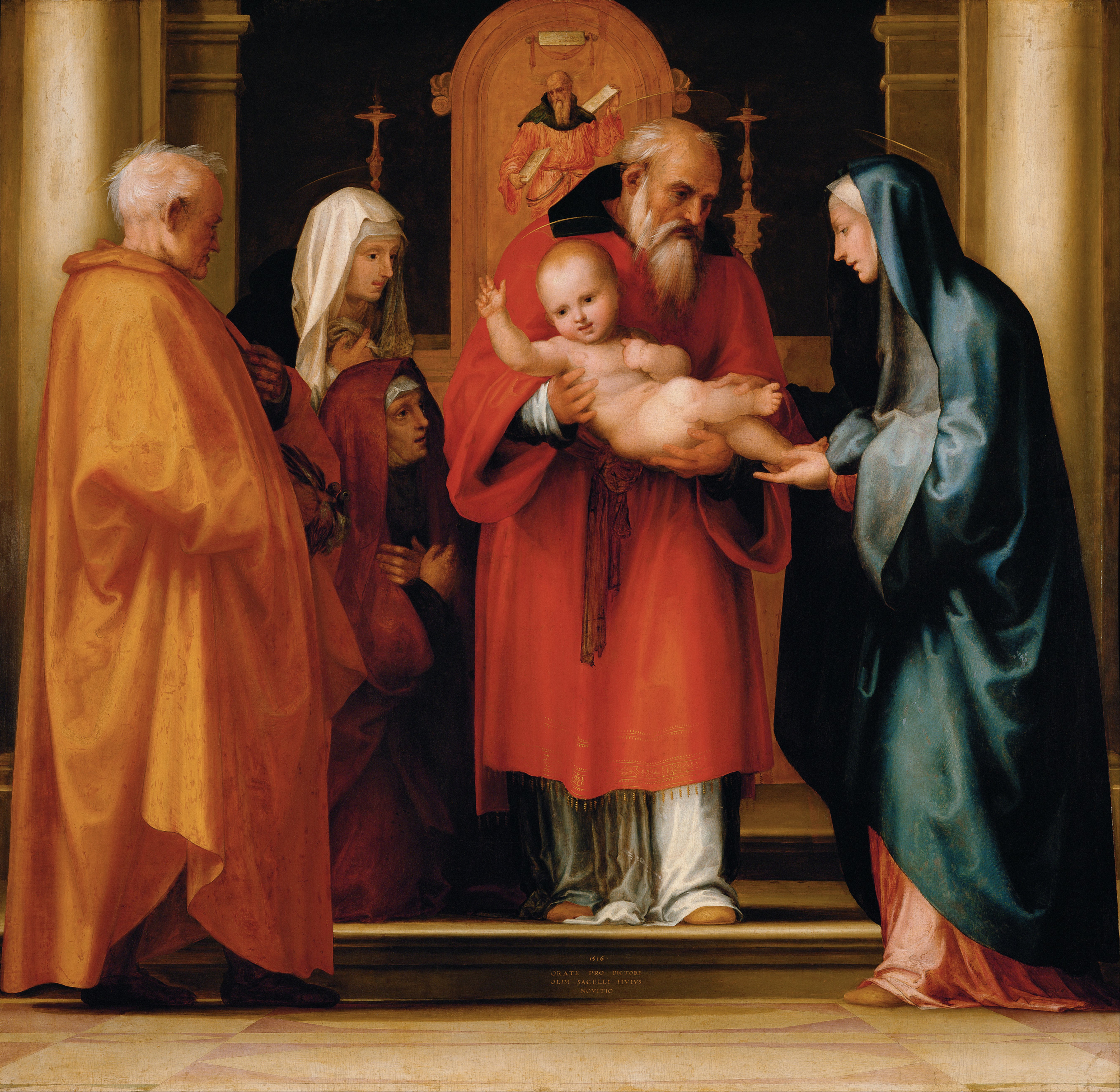
The Three Legal Rites of the Lord’s Presentation in the Temple
Circumcision of Jesus (Luke 2:21): The Eighth Day and the Bestowing of a Name
In accordance with Jewish law, this commandment was to be fulfilled on the eighth day after birth, and at this time, the boy was given the name Jesus, already revealed by the angel Gabriel.

Redemption of the Firstborn (Exodus 13, Luke 2:23): The Five Shekels and Mosaic Law
It was a norm applicable to male firstborn Jews. Every firstborn son was to be consecrated to the Lord, in memory of God’s destruction of the firstborn of Egypt. In fact, only the Levites remained in service to the Lord, while the firstborn of the other tribes were redeemed from the age of one month by paying five shekels.
Ritual Purification (Leviticus 12): The Forty Days and the Offering of Two Turtledoves
This ritual involved a forty-day period for the purification of mothers after giving birth, as outlined in the Book of Leviticus. An offering of two turtledoves was made to symbolize the purification and the acceptance of the mother and child into religious community life.
The Purification of Mary and the Presentation of Jesus in Luke 2:22-24: Clarifying Misconceptions
The Unique Focus on Women
The practice was exclusively for women. Upon giving birth to a son, a woman would contract legal impurity for forty days, after which she was to present herself at the sanctuary to be declared pure through a purificatory rite. At this time, the newly-weaned mother offered a one-year-old lamb as a burnt offering, or a pigeon or turtledove as an expiatory sacrifice. Poor women could substitute a pair of pigeons or doves for the lamb.
Inaccuracies and Narrative Tension in Luke 2:22-24
Verses 22 Observations:
- It states, “when the time of their purification came,” implying both parents needed to undergo the rite, while only the mother was required.
- The offering of a pair of pigeons seems more related to redemption than purification.
- No mention is made of the five shekels payment.
Suggested Explanations:
These inaccuracies may indicate a superficial knowledge of Judaism and a lack of detail knowledge, unlikely from an author raised in a Jewish environment in Palestine. Several explanations are possible:
– In ancient times, practical application of norms could vary according to living traditions unknown to us, where combining the redemption and purification ceremonies might have been a local practice for convenience.
– Some scholars suggest Luke drew inspiration from the story of Samuel, establishing parallels:
– Elkanah and Hannah go to Shiloh sanctuary to dedicate their son to the Lord after his miraculous conception. Joseph and Mary ascend to the temple to present Jesus, conceived miraculously by the Holy Spirit.
– Eli blessed Samuel’s parents annually when they visited Shiloh. Simeon blesses Jesus’ parents.
– In Shiloh, women served at the entrance of the tabernacle. Ana never left the temple in Jerusalem.
– Samuel grew in stature and favor with God and men. Jesus grew and became strong in wisdom, and the grace of God was upon him.
– A difference: while Samuel remained in the temple, Jesus returned home with his parents.
Interpretation of “Their Purification”:
The term “their purification” refers to the entire nation of Israel, whose liberation and sanctification are also celebrated by Hannah and the priest Zacharias. Valid reasons for this interpretation include:
– Similarity and correlation between the beginning (v. 22) and end (v. 38) of the pericope, where “their purification” seems to refer to Jerusalem, symbolizing all Israel.
– Other instances in the Gospels use “them” to indicate Jews, e.g., “in their synagogues”. (Matthew 1:39, 4:23, 9:35, 10:27, 13:54)
– Malachi, in a prophetic text, speaks of purification similarly, referring to the children of Levi. (Malachi 3:3)
The Significance of Mary’s Purification in the Gospel (2 February Feast of Presentation)
If, therefore, the primary concern of the evangelist is not Mary’s purification but that of the people, then any inaccuracies lose their assigned importance. The evangelist aims to demonstrate through his narrative that with His journey to Jerusalem and entry into the temple—a symbol and ideal compendium of all Israel—and His consecration to the Father, Jesus accomplishes the spiritual purification of the Jews prophesied by the prophets.
The Shift in the Feast’s Name: From “Purification of Mary” to “Presentation of the Lord”
The change from the original name of the feast, “Purification of Mary,” to “Presentation of the Lord” is dictated by the Gospel of Luke 2:22-40, which first recalls Jesus’ presentation in the temple and only marginally mentions Mary’s purification.
Ritual Purification of Women After Childbirth According to Leviticus 12
Every woman who gave birth needed to be purified because, according to contemporary beliefs, blood was considered the source of life and belonged solely to God, the source of all life. Any loss of blood, including that from childbirth, made a woman impure as she was not in perfect communion with God. To restore this communion with God, the source of vital energy, the purification rite was performed. A woman remained impure for forty days after the birth of a son and eighty days after the birth of a daughter. During this period, she could not touch anything sacred or enter places of worship.
Redemption of Firstborn Sons: Exodus 13:2, 12-13 and Numbers 18:15-16
The concept of redeeming firstborn male children has its roots in traditions and laws found in the Old Testament of the Bible. This custom is primarily associated with the nation of Israel and reflects the importance given to firstborns in Jewish culture and religion. It symbolizes the dedication and recognition of the special role of firstborns in Jewish tradition. For biblical examples, we refer to Exodus 13:1-2, 11-15, Numbers 3:40-51, 18:15-16.
Mary and Joseph’s Obedience to Moses’ Law: Luke 2:39 and Fidelity to Jewish Halakha
In his narrative, Luke emphasizes Mary and Joseph’s obedience to the law and highlights Jesus’ presentation in Jerusalem. He states twice that they brought the Child to be presented to the Lord. The prophetic words of Simeon and Anna are directed primarily at the Child, the Messiah of the Lord. The focus is not so much on the presentation but on the consecration of Jesus.
Rather than a firstborn to be redeemed, Jesus seems like an offering to be presented to the Father. This sacrificial interpretation is reinforced by several details:
The Redemption of the Firstborn and Mary’s Presentation in the Temple
- There is no document that specifies the temple as the place for the redemption of the firstborn; parents could present themselves to any priest.
- The reason Mary and Joseph took the boy to Jerusalem was to ” offer him to the Lord,” a phrase echoing numerous Old Testament passages describing the offering of victims in sacrifice (Lev 16:7, 10) or individuals dedicated to serving the Lord like the Levites (Num 8:13, Deut 10:8). Paul will use similar terms to exhort Christians to offer their own bodies as living sacrifices, holy and pleasing to God (Rom 12:1).
- Why doesn’t Luke mention the price paid for the redemption? Because Jesus, though not of the tribe of Levi, did not pay a ransom for his release but remained forever consecrated to God, to whom he would offer his life as an eternal sacrifice.
Mary’s Understanding of Her Son’s Dedication
Already on this temple visit, Mary, who keeps and meditates on all these things in her heart, begins to grasp that her son does not belong to her but is forever given over to God. Her action holds value as a consecration of the Son, in which she associates herself almost as one entity with him. Thus, we can speak of a ” purification-consacration” involving both mother and child, perhaps explaining why Luke refers to their purification.
Simeon: The Just One Waiting for Israel’s Consolation (Luke 2:25-32)
Simeon is described by Luke with three attributes placing him in the tradition of the righteous of the Old Testament: he is just, pious, and awaited the consolation of Israel (Luke 2:25). The Holy Spirit rested upon him and revealed that he would not die before seeing the Messiah of the Lord. Moved by the Spirit, he ascends to the temple on the day Mary and Joseph enter with the Child. He takes Jesus in his arms and proclaims one of the most beautiful hymns in the New Testament, the ” Nunc Dimittis“: “Now Lord, you can bid your servant depart in peace, according to your word, for my eyes have seen your salvation” (Luke 2:29-30). In this brief hymn, Simeon encapsulates all of Israel’s messianic hope: salvation is an already fulfilled event, visible, concrete, and incarnate in the Child he holds.
Simeon’s Sword (Luke 2:35): Four Patristic Interpretations of Its Mariological Symbolism
… (The text provided does not include content for this section.)
After blessing the parents, Simeon turns specifically to Mary and pronounces the central prophecy of the entire pericope: “See, this child will be a cause of falling or rising for many in Israel, and he will be a sign of contradiction. For yourself, a sword shall pierce through your very soul” (Luke 2:34-35). The image of the sword is deliberately ambiguous, and its interpretation has occupied patristic and medieval exegesis for centuries.
The most widespread interpretation in tradition is that of Mary’s pain at the foot of the Cross: the sword represents the maternal suffering before the Passion and death of her Son. Origen proposed a different reading: the sword would be the doubt or turmoil in Mary’s faith during the Passion, when the scandal of the Cross could also shake the Mother. Both readings, though distinct, converge on one point: Mary’s life will not be a tranquil path of glory but a participation in the redeeming destiny of her Son. Simeon’s prophecy is, in this sense, the announcement of all devotion to the Seven Sorrows of Mary.
The expression “sign of contradiction” refers to Jesus but also illuminates Mary: she who generated him and accompanied him will inevitably be a sign of the same contradiction. Being the Mother of the Messiah is not a privilege lived on the margins of history, but a vocation that permeates the flesh of history.
Anna, the Prophetess (Luke 2:36-38): The Tribe of Asher, an Eighty-Four Year Fast, and Recognition of the Messiah
Luke adds a second prophetic figure: Anna, daughter of Phanuel, from the tribe of Asher. She had been a widow for seven years and, since then, had not left the Temple: she served God day and night with fasting and prayers. At eighty-four years old, she arrived at the same time and gave thanks to God, speaking about the Child to all who were waiting for the redemption of Jerusalem (Luke 2:38). Anna is the first temple evangelist: she announces salvation not to a single man, like Simeon, but to a community, to those waiting for the fulfillment of promises in the holy city. Her presence in Luke’s narrative emphasizes that recognition of the Messiah takes place in prayer, silence, and perseverance.
Also see: Presentation of Jesus at the Temple (Luke 2:22), liturgical and mariological analysis of the feast of Candlemas.
Graduate Studies in Mariology
Do you wish to deepen your formation in Mariology? Discover the Graduate Program in Mariology from Locus Mariologicus: an academic formation that combines theological rigor, spiritual life, and the living tradition of the Church.
📖 Seriously interested in studying this? Explore the Graduate Program in Mariology from Locus – a rigorous academic formation for theologians, priests, religious, and laity.

Responses