Why is May dedicated to Mary?
Origens Antigas no Egito e Oriente
The Marian celebration has its deep roots in history, originating first in the East and then spreading to the West. It is not a matter of centuries but of millennia. In Egypt, between the sixth and seventh centuries, there was already the daily liturgy of the month Kiatk (from December 10 to January 8), dedicated to the preparation for Christmas and the praise of the Virgin Mary.
Esta liturgia era composta por quatro partes:

- Um canto poético louvando a Mãe de Deus;
- Um salmo de louvor à Virgem;
- Uma paráfrase de palavras e episódios bíblicos sobre Maria;
- Um comentário com aplicações à vida cristã.
In the 11th century, fasting was added to Marian praise to recall the persecutions that Mary would have suffered in the last month of her pregnancy due to malicious tongues, intensifying her longing for the birth of Jesus.
For Egyptian Christians, the Marian month is December, while for the Greeks it becomes August. The Byzantine Marian month centers on the feast of the Assumption or Dormition, dividing it into fifteen days of preparation and as many days of celebration.
A Tradição Ocidental: Philippe de Harveng e Annibale Dionigi
In the Western tradition, two names stand out as historical milestones of the Month of Mary: Philippe de Harveng (died in 1183) and Annibale Dionigi (1646). They played crucial roles in promoting and formalizing devotion to the Marian month.
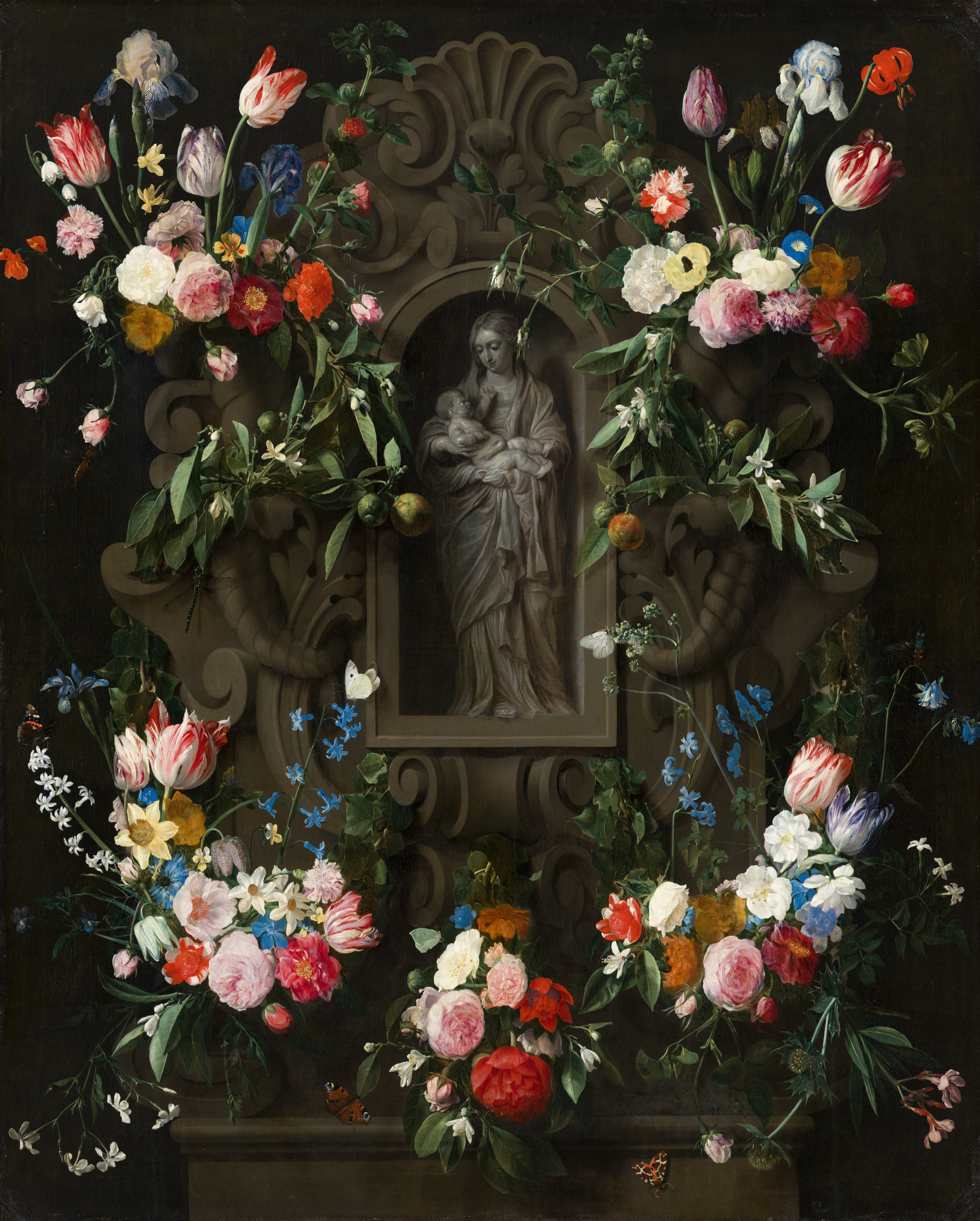
Not for liturgical reasons, as in Egypt or Constantinople, but for reasons of natural and affective order, the celebration of May as the month of flowers and the beginning of new life dates back to pre-Christian times. In ancient Greece, May was dedicated to Artemis, who, among other things, was the goddess of vegetation and fertility. In Rome, Flora, the deity of plants, especially the flowering of grains, was revered. In her honor, at the end of April or beginning of May, the Ludi Florales took place, interceding for all that flourished.
During the Middle Ages, this tradition continued with the expulsion of winter or the introduction of spring. The first day of May long retained its significance as the start of growth, a day of luck when the earth sent forth its fruits upward. The connection to vegetation remained for this day and then for the entire month. May has been considered since ancient times as the time of flowering and brilliancy of nature. As a transitional phase to later Marian devotion, the consecration of an entire month to Mary emerged, which eventually led to the special Marian devotion in this month.
One of the earliest evidences of Marian devotion in May comes from King Alfonso X, King of Castile (d. 1284). Among his 428 Cantigas de Santa Maria (Songs of Saint Mary) he composed, is found the song Mayo Ben vennas, May. Here, the greeting of May is combined with praise and supplications to Mary:
|
Bem-vindo, Maio, e com alegria. Por isso roguemos a Santa Maria Que ao seu Filho rogue todos os dias Para que ele nos guarde de erro e de loucura. Bem-vindo, Maio. Bem-vindo, Maio, e com alegria. |
Bem-vindo, Maio, com toda saúde. Por isso roguemos à de grande virtude Que a Deus rogue que nos ajude sempre Contra o demônio e disso nos proteja. Bem-vindo, Maio, e com alegria. |
|
Bem-vindo, Maio, e com lealdade. Por isso roguemos à de grande bondade Que sempre tenha misericórdia de nós E nos guarde de toda maldade. Bem-vindo, Maio, e com alegria. |
Bem-vindo, Maio, com muitas riquezas. E nós roguemos à que tem nobrezas Em si muito grandes, que nos livre de tristezas E nos defenda de aflições e dores. Bem-vindo, Maio, e com alegria. |
|
Bem-vindo, Maio, coberto de frutas. E nós roguemos à que sempre dá Às suas mercês em muitas coisas, Para nos defender do demônio e suas lutas. Bem-vindo, Maio, e com alegria. |
Bem-vindo, Maio, com bons sabores. E nós roguemos e damos louvores À que sempre por nós pecadores Roga a Deus, que nos guarde de dores. Bem-vindo, Maio, e com alegria. |
|
Bem-vindo, Maio, com vacas e touros. E nós roguemos à que nos tesouros De Jesus Cristo é, que aos mouros Logo confunda, e brancos e loiros. Bem-vindo, Maio, e com alegria. |
Bem-vindo, Maio, alegre e sem sanha. E nós roguemos à quem nos ganha Bem de seu Filho, que nos dê tamanha Força, que saiam os mouros da Espanha. Bem-vindo, Maio, e com alegria. |
|
Bem-vindo, Maio, con muitos gãados. E nós roguemos à que os pecados Faça que nos sejam de Deus perdõados, Que de seu Filho nos faça privados. Bem-vindo, Maio, e com alegria. |
Bem-vindo, Maio, con bão verão. E nós roguemos à Virgem do chão Que nos defenda de homem muito vilão E de atrevido e de torpe caluniador. Bem-vindo, Maio, e com alegria. |
|
Bem-vindo, Maio, con pan e con vo. E nós roguemos à que Deus menino Trouxe em seus braços, que nos dê camo Para que sejamos com ela em festim. Bem-vindo, Maio, e com alegria. |
Bem-vindo, Maio, manso e não irado. E nós roguemos à que nosso escudo É, que nos guarde de louco atrevido E de homem mau e desconhecido. Bem-vindo, Maio, e com alegria. |
|
Bem-vindo, Maio, alegr’ e fremoso. Por isso à Mãe do Rei glorioso Roguemos que nos guarde do nocivo Homem e de falso e de mentiroso. Bem-vindo, Maio, e com alegria. |
Bem-vindo, Maio, con bõos manjares. E nós roguemos em nossos cantares À Santa Virgem, diante dos seus altares, Que nos defenda de grandes pesares. Bem-vindo, Maio, e com alegria. |
Devotion to Mary in May: A Historical Overview
In Toulouse during the 14th century, Provençal floral games held on May 1st featured poems praising Mary. Jesuit Jakob Balde (d. 1668) also composed an ode to Mary on May 1st, 1641, depicting her entrance into nature as springtime. The Dominican blessed Heinrich Suso (d. 1365), deeply devoted to the Virgin, dedicated the floral season of spring annually to Mother Mary. His influence was followed by Benedictine Wolfgang Seidl (d. 1562), who, in his booklet ‘Spiritual May’, responded to pagan festivals by proposing special tributes to Jesus and Mary.
Beyond specific dates and Marian devotion, there exists a unique form of Marian devotion spanning 30 or 31 days. For instance, the 30-day period between August 15th (Assumption) and September 14th (Exaltation of the Cross), chosen as a model for the celebration of Marian devotion in May.
During the Baroque era, indications emerge of practices dedicated to Mary for an unspecified month. This month was not tied to any calendar date, allowing for Marian devotions of 30 or 31 days to commence at any time. Jesuit Johannes Nadasi (d. 1679) illustrated this in his work ‘Theophilus Marianus’ (1664), proposing 31 Marian exercises without mentioning May.
A codex preserved in San Domenico di Fiesole describes the actions of Dominican novices in 1676: upon the arrival of Calendimaggio, they celebrated Mary with songs and floral offerings, following the example of their contemporaries who sang to their brides. This custom later extended to all days of May. Perhaps a transition from 31 days to May as the month for this devotion can be traced through Capuchin Laurentius von Schnüffis (d. 1702) in his work ‘Mirantische Mayen-Pfeiff’ (Flauta de Maio de Mirantis), where he transposes the image of spring to Mary: Mary is the spring of grace after the winter of destruction.
The Universal Spread of Marian Devotion in May: Paul VI’s Mense Mayo (1965) and Modern Liturgical Reception
The greatest impetus for May as a Marian month came from 18th-century Jesuits. One notable figure was Father Annibale Dionisi of Verona, who published ‘The Month of Mary’ in 1725, outlining the elements that would solidify the Marian month: prayer (including the Rosary and litanies), contemplation, virtue offerings, and jaculatory prayers.
In 1785, the first edition of ‘The Month Dedicated to the Great Mother of God’ was released in Ferrara by Jesuit theologian Father Alfonso Muzzarelli (d. 1813). He proposed sending this booklet to all Italian bishops for implementation in their dioceses. The practice gained widespread adoption, becoming prevalent in nearly every Catholic parish worldwide by the mid-19th century.
This work recognized the spiritual fruits borne by the celebration of the Marian month:
- instruction in the truths of faith,
- religious experience within popular songs and solemn rites,
- encountering communal prayer with Mother of God,
- growth in trust in Mary,
- formation of will in the daily commitment’s realization.
May, the Month of Mary, and Flowers: The Symbolic Spring, the Song of Songs (Ct 2:11-12), and Nature Tradition
A Primavera e a Veneração de Maria
The spring begins on March 21st, marking the blossoming of nature not only in the northern hemisphere but worldwide from May onward. Historically, the veneration of Mary took place on any date for a period of thirty consecutive days, as seen in the Middle Ages, where devotion to Mary was common in May, although not necessarily throughout the entire month.
Over time, various forms of Marian devotion in the spring concentrated on the month of May, making it the quintessential Marian month. May, with its beauty and flowers, seemed naturally suited for such dedication. Furthermore, the choice of May was influenced by the fact that this month did not have its own Marian feast, thus offering the opportunity to be voluntarily dedicated to Mary.
A Escolha de Maio
The work Marianische Maiandacht oder der Verehrung Mariens gewidmeter Mai-Monat (May Marian Devotion or the Month of May Dedicated to the Veneration of Mary), published in Regensburg in 1839, emphasizes: “When one always chooses the most beautiful, the best, and the most pleasing for a sacrifice, then the preference is given to the month of May, the most beautiful of months.”
Evolução da Devoção de Maio
The celebration of the devotion of May usually spans the entire month, integrating with monthly devotions that emerged in the 19th century, such as the devotion to the Sacred Heart of Jesus in June and the rosary in October. From the second half of the 19th century, the month of May became the most significant form of Marian devotion, with requests from the faithful for its introduction. Many bishops showed their support through active participation in the celebrations.
The decisive impetus for the devotion of May came with the dogmatization of the Immaculate Conception in 1854. In several dioceses, the dogma was officially proclaimed in May of the following year, often in connection with the month’s celebrations. Notable political and ecclesiastical events frequently served as justification to highlight the month of May, such as during both World Wars.
During the First World War, Pope Benedict XV ordered in 1915 that an prayer for peace, written by himself, be made during the month of May. The month of May was once again recommended during the Second World War, with Pope Pius XII calling on the faithful in 1939 to pray and practice special devotions in May for peace among nations.
O Problema Litúrgico do Mês de Maio
The current relevant liturgical question is how to reconcile the devotion of May with the fifty-day Paschal period emphasized by the Second Vatican Council. The rhythm of the weeks of Easter extends until approximately May, and the Council wishes that the liturgical year be organized to preserve the original character of these times (Second Vatican Council, Sacrosanctum Concilium, 107).
The Universal Norms of the Liturgical Year and the new Roman Calendar clearly state: “The fifty days between Easter Sunday and Pentecost Sunday must be celebrated with joy and exultation as though they were one single day of festivity, or better still, a great Sunday” (n. 22).
A simple devotion to Mary, as traditionally practiced in May, cannot meet this requirement, overshadowing the Paschal theme of these weeks. For an adequate renewal of May devotions, it is necessary to consider that the Paschal period is the fundamental magnitude, and thus, if May approximately encompasses this period, the Marian piety associated with it should be aligned with the Paschal theme. The Paschal theme should not be subordinated or postponed in relation to the month of May and its piety.
Renovação da Devoção de Maio
After a period of crisis following the Second Vatican Council, the month of May has experienced a renaissance. This is evidenced by an increase in publications on the subject. Even with special emphasis on Advent as an appropriate time for devotion to the Mother of the Lord (Apostolic Exhortation Marialis Cultus, 1974), contemporary Christians can benefit from a renewed celebration of the month of May.
This renewal should not be a passive repetition of the past but a reinterpretation in accordance with the guidelines of the Second Vatican Council (Lumen Gentium, 1964; Marialis Cultus, 1974; Directory on Popular Piety and the Liturgy, 2002). The celebration of the Marian month should be more biblical, harmonized with the liturgy, highlighting the Virgin’s participation in the paschal mystery and at Pentecost, more Christ-centered and ecclesial, and attentive to the challenges of the contemporary world.
Above all, the Marian month should preserve and intensify its prayerful character, providing a religious experience of God revealed through fervent prayer to Mary and with Mary, a living and glorified person, mother and model of the Church.
The magisterium of Paul VI, in the document Marialis Cultus, values Marian devotional practices throughout the liturgical year, emphasizing the importance of devotion to Mary at all times of the year.
Deepen your studies: explore Mariology, Marian Theology, Marian Apparitions and the Master’s in Mariology.
Master’s in Mariology
Want to deepen your formation in Mariology? Discover the Master’s in Mariology from Locus Mariologicus, an academic formation that combines theological rigor, spiritual life, and the living tradition of the Church.
Would you like to study Mariology seriously?
This article draws on the works of the Locus Mariologicus library. The Postgraduate Programme in Mariology takes you to the same sources with academic guidance: Scripture, the Church Fathers and the Magisterium, from the first dogma to contemporary questions.
Responses