Catholic Angelology: Angels, Hierarchies, and Church Doctrine
Introdução
Angelology is the branch of theology that explores the nature, organization, and role of angels in the universe, as revealed by Catholic doctrine. When the Christian faith affirms the creation of the “visible and invisible universe” by the omnipotent God, it recognizes that there is a spiritual dimension beyond physical matter. Angels are an integral part of this invisible creation. This article presents, concisely and from a Catholic perspective, what angels are, their hierarchical structure, their place in Sacred Scripture, and the teachings of the Church’s Magisterium.
O Que é Angelologia?
The word “angelology” derives from the Greek ángelos, meaning “messenger.” It involves the study of the nature, hierarchy, and mission of angels, as well as the fall of the rebellious angels, known as demonology. It is important to distinguish its method of investigation: experimental sciences do not deny the existence of angels but cannot study them directly, as they escape measurement. Confusing this limitation with a denial of reality is a philosophical choice, not a scientific one. Theology, on the other hand, interprets and discerns in the light of Revelation and reason.
Quem São os Anjos?
A tradição patrística estabeleceu três afirmações fundamentais sobre os anjos:
- Criaturas: Os anjos são seres criados, nem deuses nem forças eternas.
- Espirituais : Eles são puramente espirituais, sem corpo físico, e existem apenas como pura inteligência e vontade.
- Providenciais: Servem ao desígnio de Deus, cumprindo suas missões divinas.
Saint Thomas Aquinas explained that, having no matter, each angel constitutes a unique species. Their knowledge is not discursive but intuitive, received directly from God at the moment of creation.
Hierarquias Angélicas: Os Nove Coros
Seguindo o Pseudo-Dionísio Areopagita, a tradição distingue nove coros angélicos organizados em três hierarquias:
- Serafins, Querubins e Tronos: Localizados mais próximos do trono de Deus.
- Dominações, Virtudes e Potestades: Responsáveis pelo governo da criação.
- Principados, Arcanjos e Anjos: Enviados para estar com os seres humanos.
Saint Thomas reinterpreted this order in cognitive terms: the more universal the knowledge received from God, the higher the hierarchical position of the angel. Of the nine categories, five have direct missions in the world: Potestates, Principados, Virtutes, Archangels and Angels.
Os Anjos na Bíblia
In Sacred Scripture, angels are never objects of curiosity but always appear in service to the history of salvation. In the Old Testament, the cherubim guard Eden (Genesis 3:24) and the Angel of the Lord accompanies the people of Israel. In the New Testament, Gabriel announces the Incarnation of Christ (Luke 1), angels sing at Christmas (Luke 2:13-14), serve Christ in the desert (Matthew 4:11), and proclaim His Resurrection (Matthew 28:5-7). Jesus’ exorcisms are linked to the coming of the Kingdom: “If I drive out demons by the Spirit of God, then the Kingdom of God has come upon you” (Matthew 12:28). The name of an angel reveals his mission: to point toward God and withdraw.
Os Arcanjos Miguel, Gabriel e Rafael
A Bíblia menciona três arcanjos:
- São Miguel: Príncipe da milícia celeste (Daniel 10; Apocalipse 12,7).
- São Gabriel: Mensageiro da Encarnação (Lucas 1).
- São Rafael: Acompanhante de Tobias (Livro de Tobias 12).
Os Anjos da Guarda
The Catholic faith teaches that each person is accompanied by a guardian angel, designated to protect and guide them toward God. This belief is celebrated by the Church on October 2nd.
Ensinamentos do Magistério da Igreja
O Magistério da Igreja interveio principalmente para defender duas verdades:
- O mundo espiritual pertence à criação divina.
- O mal não é um princípio absoluto, mas uma consequência da liberdade de escolha dos seres criados.
The Fourth Lateran Council (1215) affirmed that God created the world and the angels from nothing, and that the Devil and the demons are good creatures who became evil by their own choice. The Catechism of the Catholic Church addresses the angels in numbers 328-336 and the fall of the angels in numbers 391-395. Later teachings were reaffirmed by Paul VI (1972), the Congregation for the Doctrine of the Faith (Christian Faith and Demonology, 1975), and the catecheses of John Paul II (1986).
A Queda dos Anjos: Demonologia
Not all angels remained faithful. Some, through a free and irrevocable choice, refused God, resulting in their fall and the emergence of the Devil and demons. Their sin was pride, a desire for autonomy from the Creator. The Catholic faith holds a realistic view: Satan is not an “anti-God” nor a cosmic force equivalent; he is a fallen creature. Evil is real but not sovereign; active but defeated. The key to understanding this lies in Easter: the cross and resurrection of Christ are the definitive victory over evil.
Maria, Rainha dos Anjos
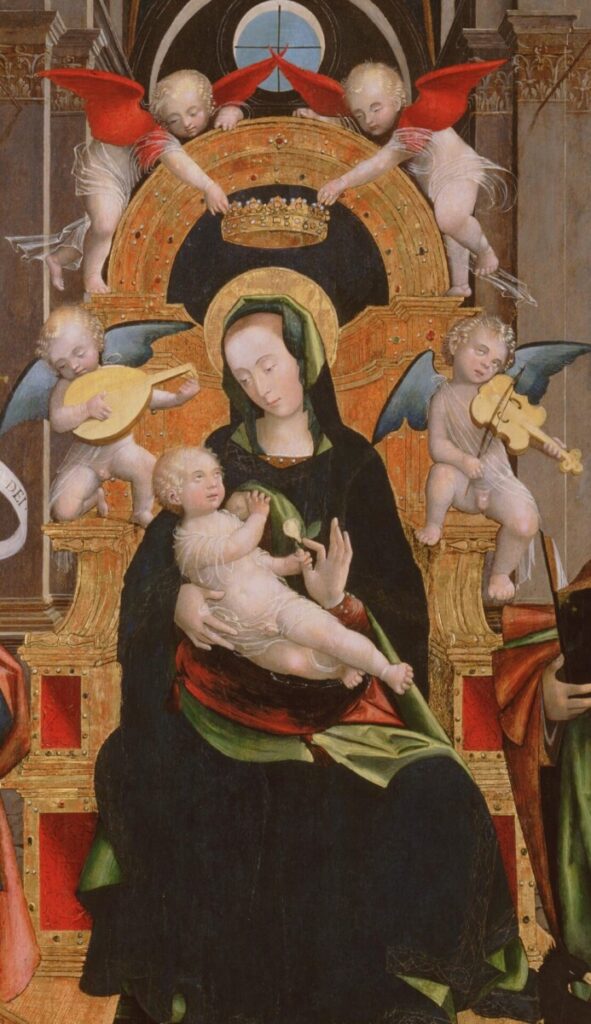
The angelology meets mariology in considering Mary as Queen of the Angels. In the Litany of Loreto, she is invoked as “Queen of the Angels (Regina Angelorum)”. As Mother of God and full of grace, Mary surpasses in dignity all the celestial choirs, having been served by them at the Annunciation of the Savior and in the adoration of the Son who gives to the world.
Fontes para Estudo Aprofundado
- A Angelologia de São Tomás de Aquino
- Os Anjos na Bíblia (Antigo e Novo Testamento)
- Denzinger – definições dogmáticas sobre os anjos
- Angelologia patrística (Padres da Igreja, séculos II-VIII)
- São Miguel Arcanjo
- São Gabriel Arcanjo
Would you like to study angelology with academic rigour?
This article draws on the works of the Locus Mariologicus library. Angelology is one of the subjects of the Postgraduate Programme in Mariology, within a 360-hour curriculum ranging from Scripture to the Church Fathers and the Magisterium.
Responses