The Visitation of the Blessed Virgin Mary
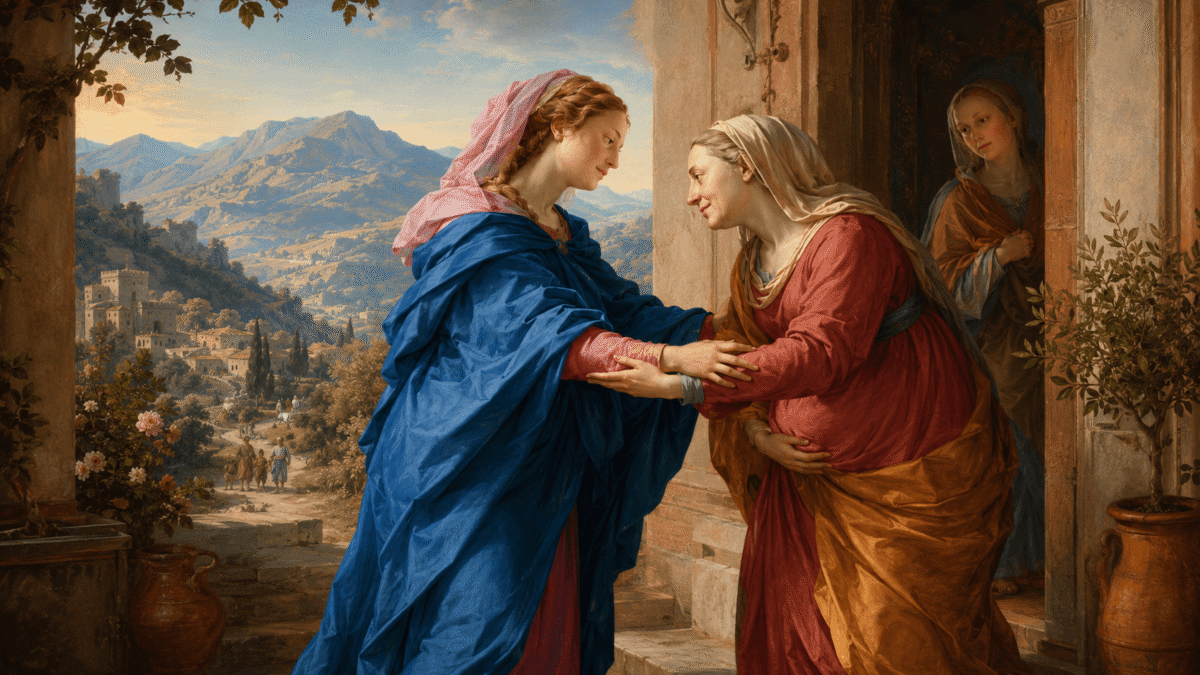
The Visitation of Mary to Elizabeth (Lk 1:39-56) is one of the central moments in biblical mariology. The Visitation of Mary reveals the mystery of the divine presence anticipated by the Holy Spirit. In the Visitation, the Mother of the Savior becomes a bearer of messianic joy announced by the prophets.
A Alegria da Presença de Deus
I. A alegria que irrompe da presença de Deus
The song of the prophet Zephaniah, which opens the reading for this Mass, highlights the joy that arises from divine presence. “Sing aloud, O daughter of Zion; shout, O Israel! Rejoice and exult with all your heart, O daughter Jerusalem!” (Zeph 3,14). The call to joy is not based on favorable circumstances but on the awareness of an inner presence: “The Lord, your God, is in your midst, a mighty one who will save; he will rejoice over you with gladness…” (Zeph 3,17). The relationship between God and his people is presented with intimacy and passion: a love that dances, sings, and overflows before the beloved creature.
This joy prophesied by Zephaniah finds its full realization in the Visitation. Mary, as Daughter of Zion, harbors within herself the unique presence of God. The promise of presence becomes flesh in Mary, who carries the very Emmanuel. When Mary visits Elizabeth, the prophesied joy bursts forth physically, with John the Baptist himself, still in the womb, exulting at the nearness of the Lord.
II. A pressa da caridade e a lógica do dom
The Lucan account of the Visitation begins with Mary in swift motion, heading towards the hill country of Judah. Her haste is not anxiety but the external expression of a charity that does not hesitate to serve. Upon receiving the angelic announcement about Elizabeth’s pregnancy, Mary departs immediately without considering human conveniences. The grace received is transformed into service offered. This dynamic is essential in Marian spirituality: Mary does not retain the gifts but spreads them to others.
The visit of Mary to Elizabeth is an act of human charity, a prophetic gesture, and a sacrament of the divine presence. It is charitable because it helps an elderly cousin in her unexpected pregnancy. It is prophetic because Mary’s arrival triggers the manifestation of the Holy Spirit. And it is sacramental because, in Mary, Christ is present in Elizabeth’s house even before being born.
III. O Magnificat: o cântico da inversão messiânica
The greeting of Elizabeth to Mary is a profound mariological confession: “Blessed are you among women… How is it that the mother of my Lord should come to me?” (Lk 1,42-43). Elizabeth, guided by the Holy Spirit, recognizes in Mary the Mother of the Lord before any human explanation. The divine motherhood of Mary is confirmed by this confession, where Mary’s faith is exalted as prior to her physical motherhood.
In response, Mary sings the Magnificat, a grand biblical poem. “My soul magnifies the Lord… For he has looked upon the lowliness of his servant” (Lk 1,46-48). Mary’s song reinterprets the history of salvation from the perspective of the small, where God brings down the mighty and exalts the humble. This inversion is not revenge, but reveals the logic of the Kingdom, where divine greatness contradicts human criteria. Mary, the “servant” (Lk 1,38.48), becomes the Mother of God, the humble exalted by all generations.
IV. Maria, portadora de Cristo e modelo do serviço eclesial
The third Mass of the Collection of Our Lady celebrates in the Visitation the mystery of Mary as the bearer of Christ to the world. The Christophora, or bearer of Christ, is not merely a metaphor but an accurate description of Mary’s mission in the economy of salvation. Mary bears Christ not only in her maternal womb but in every act of service, transforming lives and bringing the presence of Christ wherever she goes.
The Church contemplates in the Visitation a model for its own existence and action. Just as Mary brought Christ to the house of Elizabeth, the Church is called to be the bearer of Christ in all ages and cultures. Mary’s service to Elizabeth is the archetype of ecclesial service: free, urgent, concrete, capable of awakening in others the recognition of the divine presence. The Magnificat, sung by Mary, continues to resound in the Vespers of the Church, reminding that the messianic joy begun in the Visitation has not ceased but continues to traverse the world through the gestures of love and service of its sons and daughters.
Master’s in Mariology
Wishing to deepen your formation in Mariology? Discover the Master’s in Mariology from Locus Mariologicus – an academic formation that combines theological rigor, spiritual life, and the living tradition of the Church.
Would you like to study Mariology seriously?
This article draws on the works of the Locus Mariologicus library. The Postgraduate Programme in Mariology takes you to the same sources with academic guidance: Scripture, the Church Fathers and the Magisterium, from the first dogma to contemporary questions.

Responses