Whoever humbles himself like a little child: the infants, St. John Mary Vianney and Mary, Master of Humility
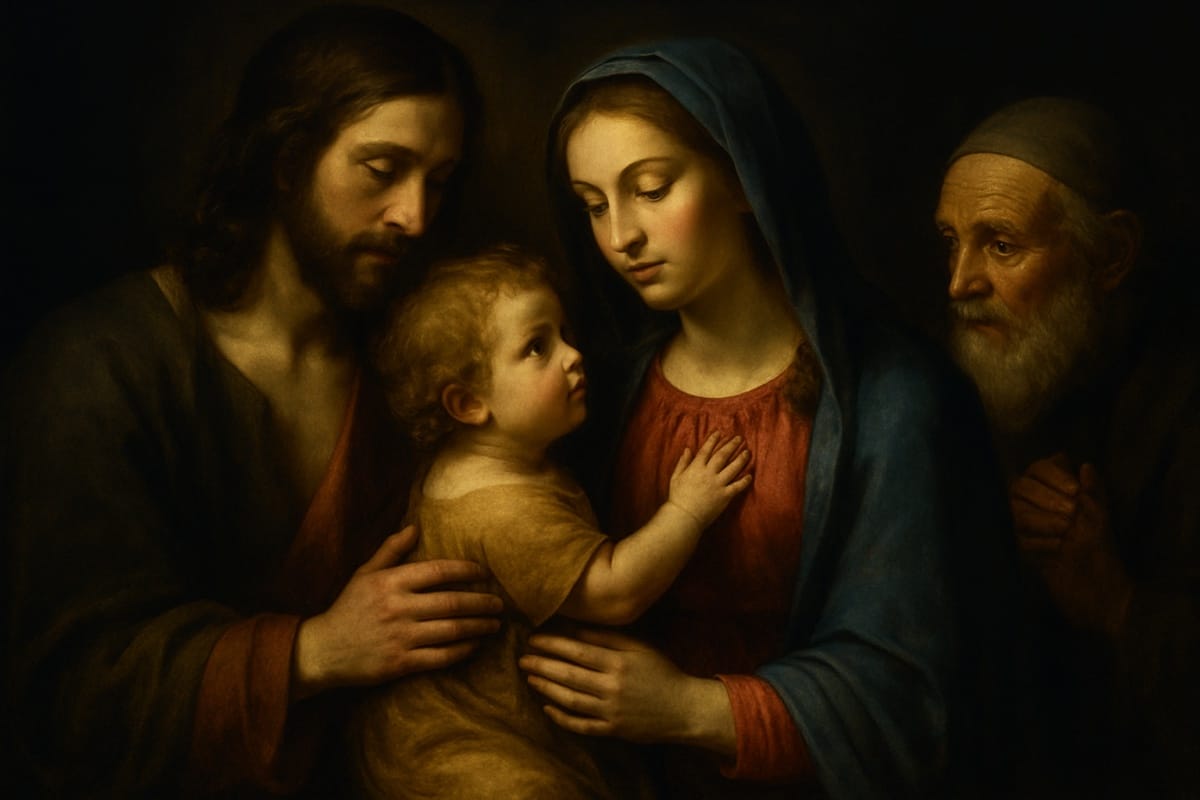
Quote:“Amen, I say to you, unless you turn and become like children, you will not enter the kingdom of heaven. Whoever then humbles himself as this little child is the greatest in the kingdom of heaven.” (Matthew 18:3-4)Text:Matthew 18:1-5.10.12-14 opens Matthew’s “Church Discourse” (Mt 18) with a question from the disciples revealing their unconverted logic: “Who is the greatest in the kingdom of heaven?” (Mt 18:1). The question presupposes that the Kingdom has a hierarchy of greatness similar to human hierarchies, and that it is worth competing for a higher position. Jesus’ response destroys this assumption: He calls a child, places her in the middle, and declares that entering the Kingdom requires becoming like a child. The child is not a symbol of sentimental innocence but of radical dependency, with no power, resources, or status of her own.The pericope also includes the parable of the lost sheep (Mt 18:12-14) and reference to the “angels of the little ones” who “always behold the face of the Father” (Mt 18:10), an image of God’s divine providence over the most vulnerable. The logic of the Church Discourse is consistent: the Kingdom is not organized according to human greatness but according to the inverse logic, the “little ones” hold the highest status, not those with more power or visibility.I. “Nisi efficiamini sicut parvuli”: Conversion to Childhood“Unless you turn and become like children” (Mt 18:3), the conversion Jesus asks for is not chronological childhood but spiritual infancy: a disposition of total dependence on God. The child Jesus places in the middle is not an abstract symbol, but a concrete child, nameless, without status. This concreteness is theologically significant: to “become like a child” is not a vague metaphor but the imitation of a specific reality, radical dependency, unfiltered openness, and inability to sustain oneself.The conversion requested is a structural metanoia: not just behavioral change but an inversion of value logic. The disciple who competes for the highest position still operates within worldly logic. The disciple who humiliates himself like a child enters Kingdom logic. This reversal is not easy or natural; it requires a “conversion” (ἐστράφητε), a heart turn that demands grace to see what human pride cannot: true greatness lies in acknowledged dependency, not won autonomy.St. John Mary Vianney (1786-1859), the Curé of Ars, whose feast is celebrated on August 4, is historically the model of this “conversion to childhood.” Intellectually mediocre in seminary studies, ordained only by persistence of the bishop and recognition of his supernatural virtues, the Curé of Ars lived the “humility of a child” not as a holiness strategy but as an honest acknowledgment of his limitations. It was precisely from this assumed smallness that arose his immense pastoral greatness, attracting hundreds of thousands of penitents to Ars.II. St. John Mary Vianney: The “Parvulus” of the ConfessionalThe sanctity of John Mary Vianney has a dimension of “smallness” illuminated by Mt 18: he did not attain holiness through theological erudition, ecclesiastical influence, or organizational ability, but through radical availability to the Spirit, prolonged prayer, and nearness to sinners. The confessor of Ars, who spent sixteen hours each day for decades in confession, is the icon of a shepherd who lets others be “small” before God without judging them.John Mary Vianney’s connection to Mary is deep and documented: his Marian devotion was filial and constant, he prayed the Rosary daily, entrusted Ars to Our Lady’s protection, and saw Mary as the model of the “small” one of the Magnificat: exalted because she recognized herself as a “humble servant.” The Cure of Ars understood his own smallness as participation in Mary’s humility, the objective humility that disposes the soul to grace.
III. Mary as “Small”: The Humility of the Magnificat
The Magnificat is Mary’s self-definition as “small” in the Kingdom: “I looked down from my height (ταπείνωσιν) upon my servant” (Lk 1:48). Mary’s humility is not a subjective virtue, but an objective condition: the young woman of Nazareth was indeed small in the world, without social visibility, political power, or resources. It was precisely from this objective smallness that God chose her. The logic of the Magnificat aligns with Mt 18: “You do not enter the Kingdom because you are great,” but “God exalts the humble.”Teresa of Lisieux (1873-1897), drawing on the Gospel, developed a spirituality of “spiritual childhood” that has Mary as its source. Teresa read the Magnificat as the formula for her own vocation: to be “small” before God, to trust in the Father’s mercy without attempting to achieve holiness through heroism. This spirituality is not passivity but active confidence: the “small” one of the Kingdom does not do less than the “great,” but does everything with the awareness that “without Me you can do nothing” (Jn 15:5).Mary, in this context, serves as a “pedagogue” of humility to the disciples who asked, “Who is the greatest?” Her response to the Angel, “Behold, I am the Lord’s servant” (Lk 1:38), is the answer of one who has already resolved the issue of greatness. Mary’s greatness, Mother of God and Queen of Heaven, arises precisely from her refusal to compete for greatness. The question “Who is the greatest?” receives from Mary the response given by the Son: the greatest is he who becomes a servant to all.IV. “Do not despise these little ones”: Protecting the Smallest
Note: This section appears to be incomplete in the provided text.«‘Do not despise any of these little ones,’ I tell you, ‘for their angels in heaven constantly behold the face of my Father.’” (Mt 18:10), the affirmation of angelic protection over the “little ones” is one of the most comforting statements from Matthew. The “little ones” who have “angels” who “constantly behold the face of the Father” are those the world tends to ignore—the powerless, the vulnerable, the voiceless. The “greatness” of these little ones before God (their angels stand before the Father) contrasts with their “smallness” before men.Mary as protector of the “little ones” is one of the most consistent themes in Marian devotion: the “Mother of the Poor” (a title given by Our Lady of Fátima), the “Protector of the Humble” (from the Magnificat: “She has brought down the mighty from their thrones and lifted up the humble”). Mary’s intercession on behalf of the little ones is not sentimental but is grounded in Christology: she who gave birth to the “Son of Man” who became “little” among the little ones (born in Bethlehem, grew up in Nazareth) is best suited to mediate the protection of this Son over the little ones throughout history.The memory of St. John Mary Vianney and the discourse from Mt 18 converge in an essential ecclesial pedagogy: the Church grows not when its members compete for greatness but when they humble themselves like children, protect the little ones, and seek the lost sheep. The Cure of Ars who spent decades at a confessional receiving “lost sheep,” Mary who intercedes for the “humble” from the Magnificat, and the disciples who learned to become “little” are the three faces of the same call: the greatest in the Kingdom is the servant of all the small.Post-Graduate in Mariology
Want to deepen your formation in Mariology? Discover the Post-Graduate Program in Mariology from Locus Mariologicus – an academic formation that combines theological rigor, spiritual life, and the living tradition of the Church.
Would you like to study Mariology seriously?
This article draws on the works of the Locus Mariologicus library. The Postgraduate Programme in Mariology takes you to the same sources with academic guidance: Scripture, the Church Fathers and the Magisterium, from the first dogma to contemporary questions.

Responses