“There was a wedding in Cana” (John 2:1)
Introduction
In Cana, located in Galilee, the famous wedding took place, of which the Gospel does not mention the names of the spouses. Some interpret this omission as a sign for a Marian spiritual reading of the episode: Jesus and Mary are the true “spouses” whose mystical wedding was celebrated in Cana.Cana of Galilee
There is no consensus on the exact location of the evangelical city of Cana. However, among the various candidates, Kafar Kanna, just 10 kilometers from Nazareth, seems to have the greatest authenticity and tradition. This city presents itself as a small urban cluster situated on a gentle slope that descends into the fertile plains of Galilee.In the 6th century, an anonymous pilgrim identified this city with that of the Gospel, locating it a day’s journey from Sepphoris. The pilgrim claimed to have used Jesus’ seat at the wedding and touched the miraculous jars, although the veracity of these claims is uncertain. What is known is that since the 16th century, the site where the current “Shrine of the Miracle” stands has been recognized as the location of the Gospel wedding, with excavations revealing a room with columns, suggesting a Byzantine basilica or Crusader construction.Recent archaeological studies, however, suggest that the room may have been a synagogue, a Jewish sacred building from the early centuries after Christ. Although it cannot be stated with certainty that it was a Christian place of worship, the monument built by the Franciscans at the end of the 19th century serves as a memorial to the Gospel episode of the miracle at Cana.“There was a wedding feast” (Jn 2,1)
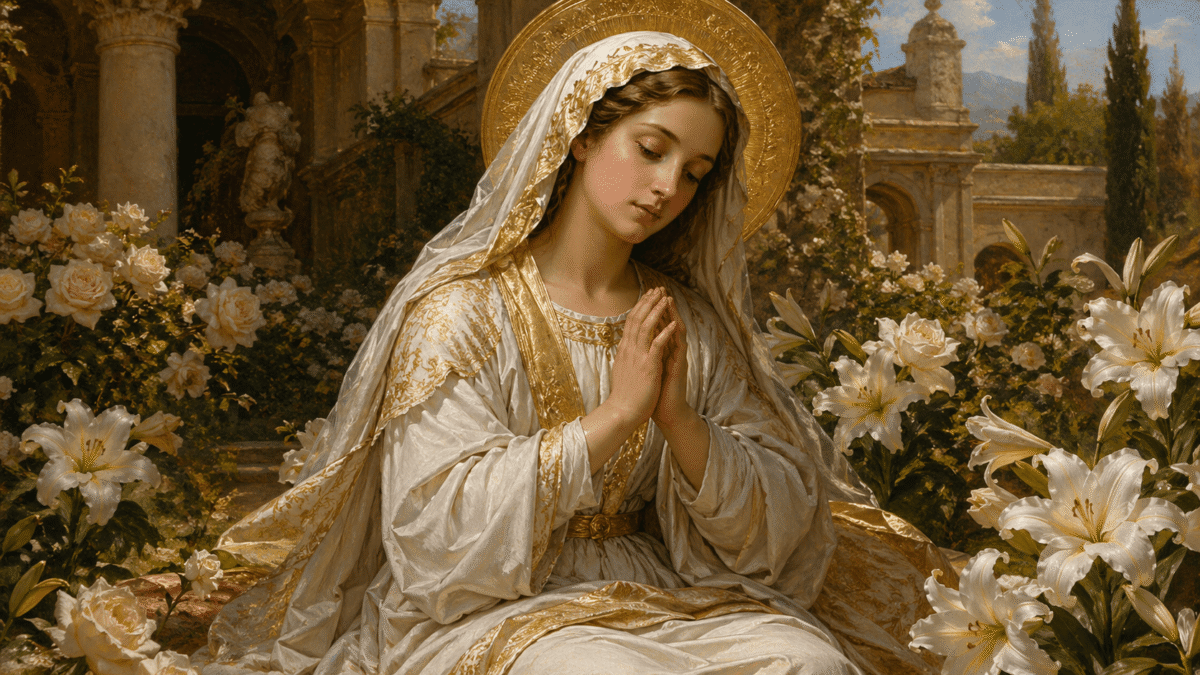
More than focusing on architectural details, it is important to remember the symbolic presence of Mary in this place. The columns and capitals of the ancient synagogue were used to build the atrium of the current church, conveying a particular serenity. At the Sanctuary dedicated to the Miracle of Cana, we contemplate the very figure of Mary, not in a specific sacred place, but in the Virgin who became the Church.The connection between the Church and Mary is significant. If we recognize in the Church the figure of the Virgin, it is not surprising to think that the elements of the ancient Jewish religion served as a basis for the faith and worship of Mary, the true mystical Church, built upon God’s definitive revelation in Jesus Christ.The Miracle of Cana and the New Covenant
The episode of Cana marks the beginning of Jesus’ public ministry, revealing His mission to teach the truth and sanctify souls. This event is often associated with the New Covenant, described metaphorically as a marriage between God and His people, just as it was with Israel. Mary, by occupying the place of the woman in Cana, foreshadows the Church, being preserved from any stain of sin and representing all the mystical people of true worshipers of God in spirit and truth (Jn 4,23).An evident parallel is drawn between Cana and the Cross: Jesus’ enigmatic response to the “Woman” (Jn 2,4) is linked to the fulfillment of that hour on the Cross (Mk 14,41), where He becomes the new Adam and the New Eve. The Church, born from Jesus’ side on the Cross, is taken from Him, just as Eve was taken from Adam.Mary, the Universal Intercessor
In contemplating Mary, the “Virgin made Church,” we can understand that Cana has more to teach. If Mary represents the true faith of the chosen people, which is realized in the revelation of the Messiah, she also plays a fundamental role as mediator of supernatural grace.Maria is not the source of grace, but through her intercession, she brings the prayers and afflictions of men to the loving Heart of Jesus. She obtains the necessary intercessions for all graces, whether material or spiritual, elevating our humanity to divine filiation and making us temples of the Most Holy Trinity.Mary, Mother of the Church
The account of Cana begins by calling Mary “mother,” understood as the mother of Jesus. Moreover, the miracle can be interpreted as a prefiguration of the sacraments of the Church: matrimony, baptism, and the Eucharist. The Church itself, born on Calvary, is compared to the water and wine flowing from the side of Jesus, symbolizing the nuptial gift left by Christ for His bride, the Church.Mary, as the Mother of the Church, continually reminds her members of the call made at Cana: “Do whatever He tells you” (Jn 2,5). At the Shrine of the Miracle of Cana and in all churches around the world, let us allow ourselves to be embraced by the Mother of the Church, who bore the Church with Christ and will assist her until the end of time.The encyclical “Redemptoris Mater” by John Paul II offers an in-depth analysis of this Johannine text within the context of Mary’s intercessory role. For a broader exploration, it is recommended to study Mariology, Marian theology, Marian apparitions, and the Postgraduate Program in Mariology.Graduate Studies in Mariology
Wishing to deepen your formation in Mariology? Discover the Graduate Studies in Mariology from Locus Mariologicus, an academic formation that combines theological rigor, spiritual life, and the living tradition of the Church.

Responses